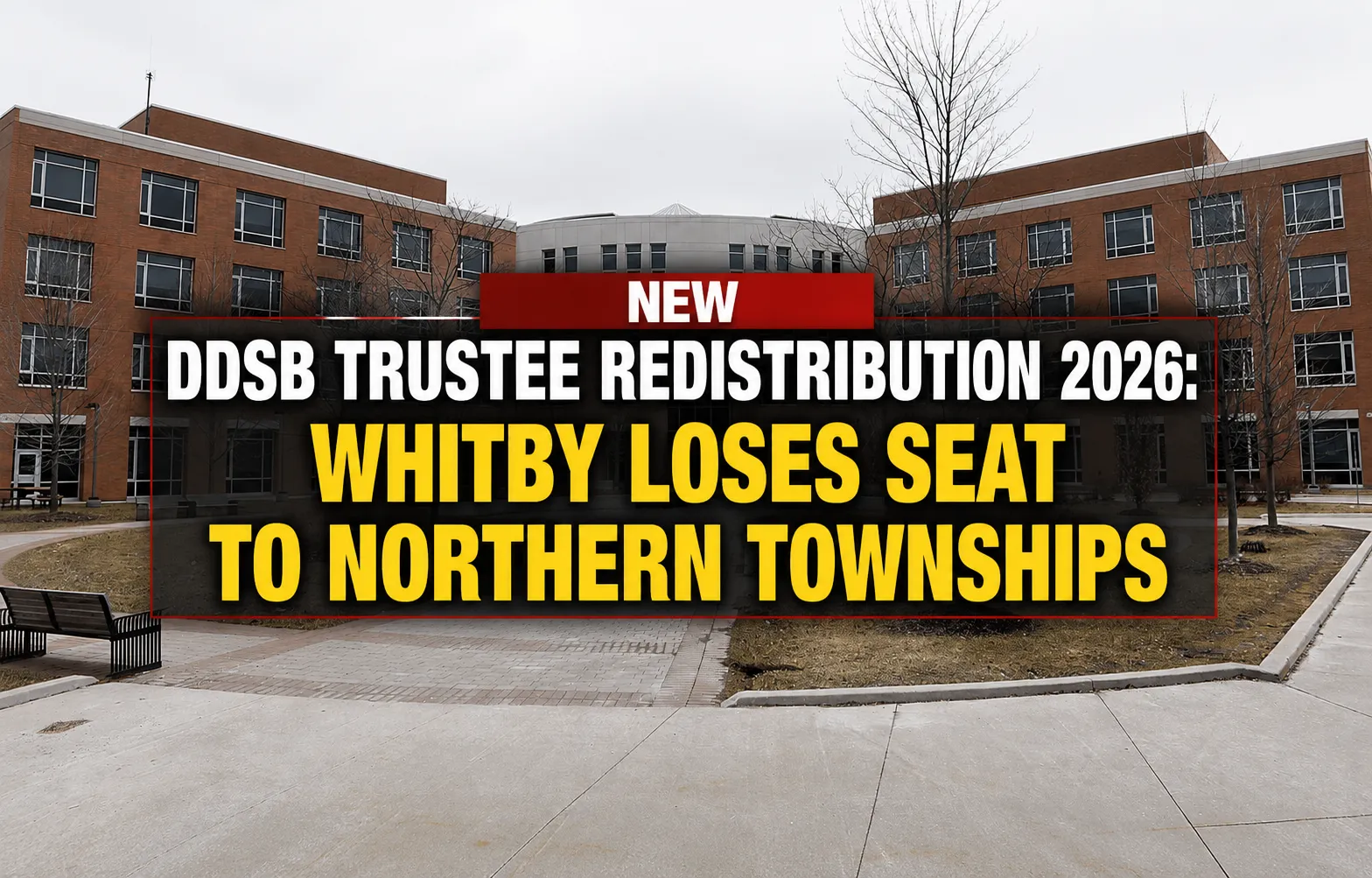
A recent shift in provincial regulations has sparked a difficult debate within the Durham District School Board (DDSB), leading to a controversial redistribution of political power. The New DDSB Trustee Redistribution 2026 plan, which originally aimed to expand the board’s reach, has been forced into a “zero-sum” scenario due to a new provincial cap on school board seats. As a result, while the northern municipalities of Brock, Scugog, and Uxbridge will successfully gain an additional trustee voice, the town of Whitby will see its representation reduced from three trustees down to two.
The conflict began following an April 13 provincial regulation that capped the number of trustees at the lesser of 12 or the board’s count during the 2022 election. For the DDSB, this limit is 11. Previously, the board had voted in March to add a 12th seat to better serve the geographically massive northern townships, which are currently represented by a single trustee. To maintain this commitment under the new provincial cap, the board had to choose between maintaining the status quo or taking a seat from an urban center. Trustees ultimately voted 5-3 in favor of the New DDSB Trustee Redistribution 2026, effectively moving a seat from Whitby to the north.
Northern trustee Carilyn Morton, who introduced the motion, argued that the three northern municipalities require a second voice to ensure equitable representation across such a large landmass. Despite recognizing that Whitby is growing “in leaps and bounds,” Morton and supporters of the motion felt that fairness demanded a more balanced geographic distribution. Trustee Shailene Panylo lamented the provincial intervention, stating that being forced to “take from Peter to pay Paul” was a loss for the region’s families regardless of the outcome, as it failed to prioritize the board’s overall population growth.


The decision has not been without its critics, particularly those representing the Whitby area. Trustee Christine Thatcher expressed deep concern regarding the New DDSB Trustee Redistribution 2026, highlighting that Whitby is one of the board’s fastest-growing sectors. With two new elementary schools opening this year and a new secondary school currently in the planning stages, opponents argue that reducing representation in high-growth urban areas could leave those families underserved. They maintain that the current three-trustee model for Whitby was necessary to manage the increasing complexity of its expanding student population.
This redistribution of seats will have a lasting impact on how local education policies are shaped and how parent concerns are addressed. The New DDSB Trustee Redistribution 2026 ensures that the rural and northern voices of Durham have a stronger seat at the table, but it leaves Whitby’s remaining two trustees with a significantly larger workload per capita. The provincial “wrench” in the board’s expansion plans reflects a broader trend of tightening municipal and educational governance across Ontario, forcing local boards to make tough choices about where to allocate limited resources.
As the region prepares for the 2026 municipal and school board elections, the New DDSB Trustee Redistribution 2026 will likely remain a hot-button issue for voters. The new geographic boundaries and seat allocations will officially take effect for the 2026-2030 term. Parents in Whitby and the northern townships are encouraged to stay engaged with board meetings as the DDSB navigates this transition, ensuring that student needs remain the priority despite the reduced number of urban trustee voices.