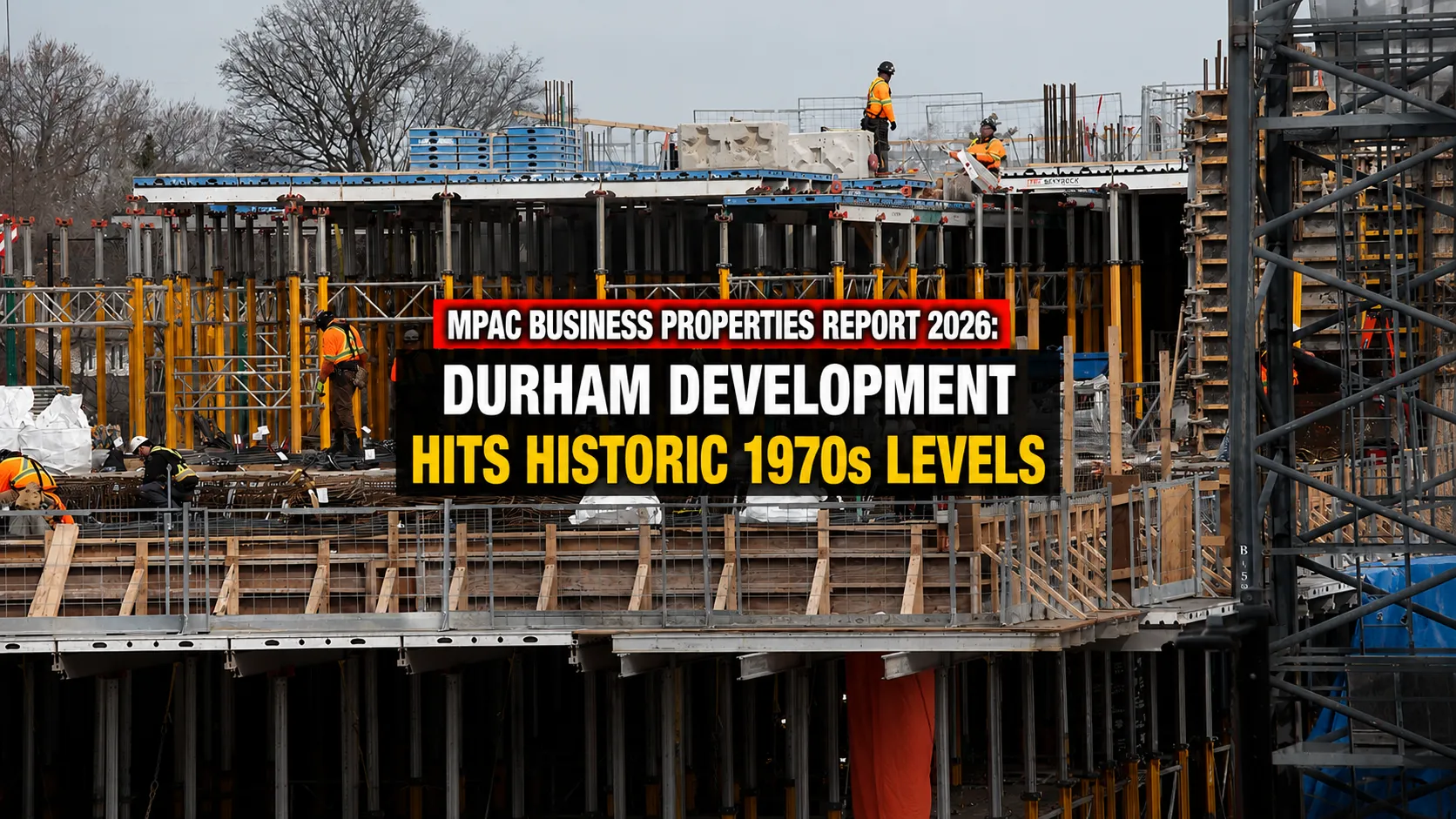
A comprehensive new report from the Municipal Property Assessment Corporation (MPAC) reveals that development activity across Ontario, including the Durham Region, has reached a fever pitch not seen in over half a century. The MPAC Business Properties Report 2026, which examines provincial trends from 2021 to 2025, confirms that the multi-residential and industrial sectors are currently the fastest-growing property groups in the province. Driven by an urgent need for housing and the expansion of e-commerce logistics, construction activity has surged to levels reminiscent of the 1970s building boom.
The MPAC Business Properties Report 2026 highlights a significant shift in the multi-residential sector. While high-rise construction continues to dominate urban skylines, there has been a notable resurgence in “walk-up” apartment developments. In 2025 alone, walk-up apartments accounted for 80% of transactions in the multi-residential category. In Durham municipalities like Oshawa and Whitby, this trend is visible as developers pivot toward mid-rise and transit-supportive housing to balance rising construction costs with high demand. However, the report warns of a dwindling supply of larger family-sized units, as new inventory is increasingly focused on one- and two-bedroom configurations.


Another key takeaway from the MPAC Business Properties Report 2026 is the explosive growth of the industrial and warehouse sector. With the continued rise of e-commerce, there is an unprecedented demand for “last-mile” delivery capabilities. Durham Region, with its proximity to Highway 401 and the 407 extension, has become a focal point for this expansion. Large-scale warehouse developments in Pickering, Ajax, and Clarington are fueling the regional economy, though the report notes this growth comes at a time when the traditional office sector remains in a state of post-pandemic “reset.”


While residential and industrial sectors thrive, the MPAC Business Properties Report 2026 indicates that the office market is facing challenges. Provincially, office vacancy rates have climbed to 16.1%, as new construction slows and existing spaces are repurposed. Interestingly, the report finds that when new office space is built, it is increasingly specialized; medical and dental office buildings now account for over 20% of new builds since 2010. For Durham’s professional hubs, this suggests a move away from traditional corporate headquarters toward health-service-oriented commercial real estate.
The data within the MPAC Business Properties Report 2026 also touches on the “hospitality” and “small commercial” sectors, which have seen a steady recovery in revenue gains. However, the oversupply of “micro-unit condos” in the broader GTA has led to a slight softening of rental rates for smaller apartments, providing a rare bit of relief for some tenants. In contrast, the lack of four-bedroom units has caused their median rent to skyrocket by 60% since 2021 in western and eastern Ontario, a trend that continues to impact growing families in the Durham Region.
As an independent, not-for-profit corporation, MPAC’s findings serve as a critical benchmark for municipal planning and property tax assessments. The MPAC Business Properties Report 2026 provides the statistical backbone for the growth strategies currently being seen in local plans, such as the Soper Springs development in Bowmanville. As Durham continues to evolve into a major industrial and residential powerhouse, these historic development levels are expected to shape the region’s economic landscape for the next decade.