










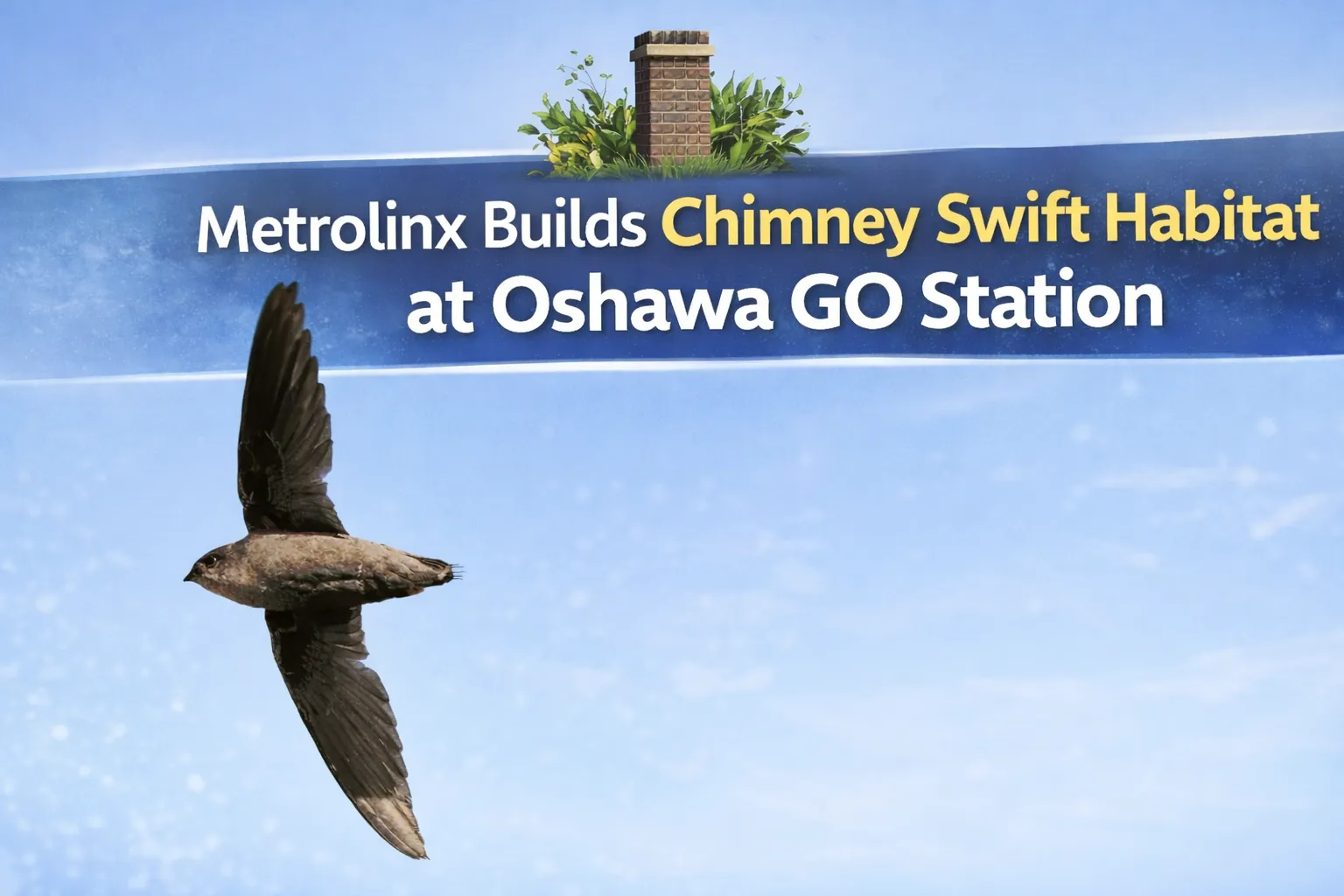
As construction continues on the future Oshawa GO Station, Metrolinx is taking steps to protect a threatened bird species by building a dedicated chimney swift habitat Oshawa GO station project at the site.
The standalone chimney is being constructed at the north end of the former Knob Hill Farms property on Howard Street. While there was no confirmed evidence that chimney swifts were nesting directly on the demolished grocery terminal structure, the birds are known to roost in the surrounding area. As a result, building the new chimney is considered an environmental requirement tied to ongoing infrastructure upgrades.


The project is connected to the demolition and rebuilding of the Simcoe Street railway bridge, a two-year construction effort that began in January. The bridge work will allow trains to run beneath it as part of the future GO Transit expansion into Oshawa and eventually Bowmanville.

Chimney swifts — unrelated to pop star Taylor Swift — are small, acrobatic birds known for their speed and aerial agility. The species plays an important ecological role by controlling insect populations. Over time, chimney swifts have adapted to rely on man-made structures such as chimneys for nesting and roosting. They are currently listed as a threatened species in Ontario, largely due to habitat loss.
Because chimney swifts commonly nest in urban areas, Metrolinx says it is taking extra precautions when transit construction intersects with potential habitats. In Hamilton, for example, a similar habitat replacement strategy was implemented during light rail transit development. In that case, a temporary chimney was built to support local swift populations while existing structures were removed.
In Oshawa, the newly constructed chimney will provide a safe nesting and roosting location for returning swifts this spring. Work began this week and is expected to be completed by April 3, with construction taking place during daytime hours between 7 a.m. and 5 p.m.
Metrolinx has also conducted wildlife monitoring in the area. A motion-capture camera installed near a culvert under the train tracks recorded more than 30 species over 11 months, including deer, raccoons, coyotes, wild turkeys and muskrats.
The former Knob Hill Farms site, once home to Ontario’s largest food terminal, is being redeveloped into a major transit hub. Oshawa’s new central GO station is one of four new stations planned in Durham Region as part of the GO Transit extension toward Bowmanville.
The chimney swift habitat Oshawa GO station initiative reflects how transit expansion and environmental protection can move forward together.