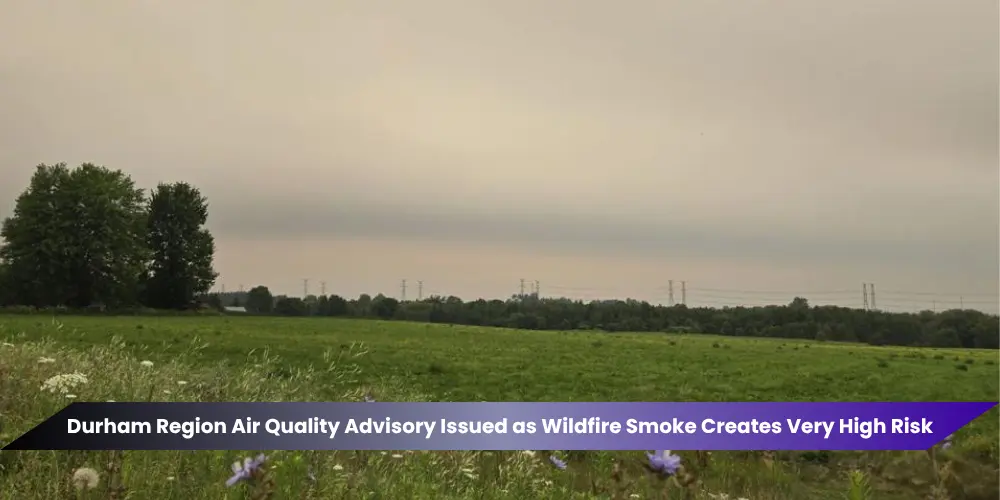
The Durham Region Air Quality Advisory remains in effect as smoke from northern wildfires continues to reduce air quality across the region, prompting health officials to urge residents to limit outdoor activities and take extra precautions.
Environment Canada issued a very high-risk air quality forecast for Oshawa on Wednesday, assigning an Air Quality Health Index (AQHI) rating of 10+. While conditions are expected to improve slightly on Thursday, forecasts still indicate a high-risk rating of 9 during the day and 8 overnight, meaning smoke will continue to impact air quality throughout the region.
Communities including Oshawa and Clarington experienced hazy skies as wildfire smoke drifted into southern Ontario. The smoky conditions have reduced visibility and increased concerns for vulnerable residents, particularly children, seniors, pregnant individuals, and people living with asthma, heart disease, or other respiratory conditions.
Health officials advise residents to reduce or reschedule strenuous outdoor activities until air quality improves. Anyone who experiences symptoms such as coughing, throat irritation, shortness of breath, chest discomfort, dizziness, or headaches should move indoors and seek medical attention if symptoms become severe.
Several municipalities and community organizations have also cancelled or modified outdoor programs and recreational activities in response to the poor air quality. Residents are encouraged to check with local organizations before attending outdoor events or activities.
To reduce exposure during the Durham Region Air Quality Advisory, Environment Canada recommends keeping windows and doors closed whenever possible, using air conditioning or air filtration systems if available, and limiting unnecessary outdoor exercise. People who must spend extended periods outdoors should monitor air quality updates and consider wearing a properly fitted respirator designed to filter fine smoke particles.
Wildfire smoke can travel hundreds of kilometres, affecting communities far from the actual fires. Even when the smell of smoke is not strong, harmful fine particulate matter may still be present in the air and pose health risks.
Officials will continue monitoring wildfire conditions and air quality throughout the week. Residents are encouraged to stay informed by checking Environment Canada forecasts and following updates from local municipalities and Durham Region Public Health.
The Durham Region Air Quality Advisory will remain in place until conditions improve, and public health officials continue to emphasize that reducing smoke exposure is the best way to protect personal health during this period of poor air quality.