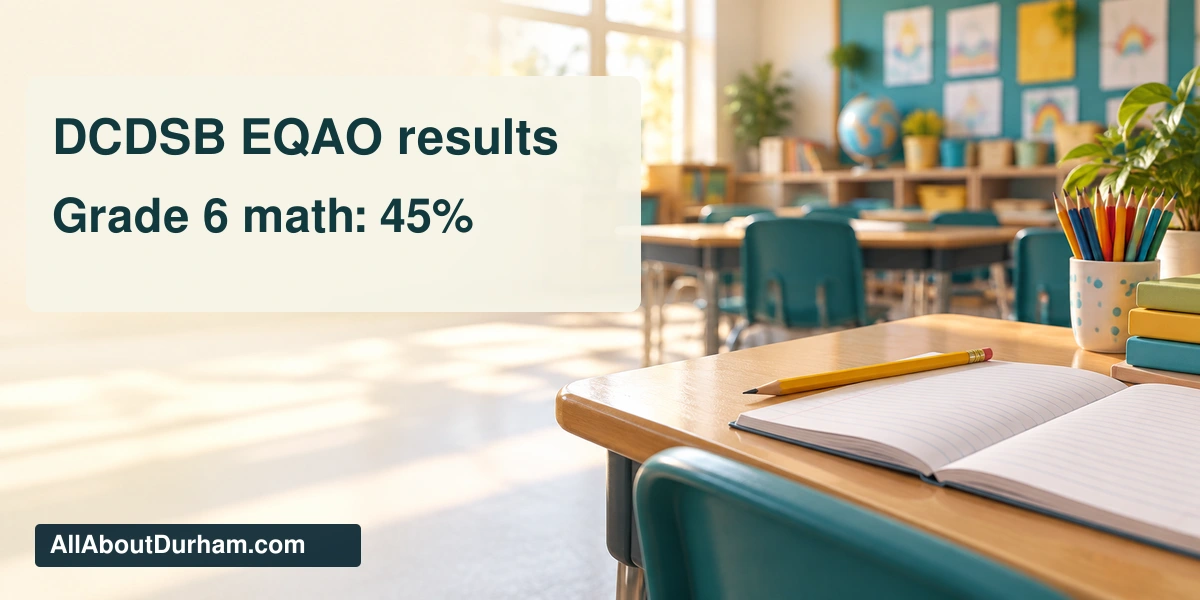
DCDSB EQAO results for 2025–26 show a mixed picture for Durham Catholic students, with stronger Grade 3 writing and Grade 6 reading results alongside a decline in Grade 6 mathematics.
The Durham Catholic District School Board released its summary on October 28. It says the overall results remain broadly consistent with previous years, while identifying the achievement gap between students with and without special education needs as a continuing priority.
For families, the figures provide a board-wide snapshot of performance on provincial tests. They do not replace classroom assessments or describe the progress of every individual student. The board says teachers also use report cards, assignments, observations and other evaluations when deciding what support learners need.
Literacy results differ by grade
Among Grade 3 students, 65 per cent met or exceeded the provincial standard in writing, up four percentage points from 2024–25. Reading stood at 72 per cent, a decline of three percentage points.
Grade 6 reading reached 88 per cent, up one percentage point. The board reported a writing result of 86 per cent, unchanged from the previous year.
On the Ontario Secondary School Literacy Test, 86 per cent of first-time eligible students passed. DCDSB says that result is above the provincial average and consistent with its previous performance. The summary does not give a new provincial percentage for readers to compare directly.
Mathematics remains an area for support
Grade 6 mathematics was the lowest of the reported subject results: 45 per cent met or exceeded the standard, down from 48 per cent a year earlier. That is a three-percentage-point decrease, rather than a three per cent relative change.
In Grade 3 mathematics, the result rose one percentage point to 61 per cent. Grade 9 mathematics also improved by one percentage point, reaching 56 per cent.
The different movements matter when interpreting the DCDSB EQAO results. The figures do not show the same trend across every grade and subject, and the board does not attribute them to a single cause in its announcement.
What schools plan to do next
For 2026–27, DCDSB says every school will share an improvement goal aimed at reducing literacy and numeracy achievement gaps for students with special education needs. Its approach combines evidence-based teaching, targeted intervention and coordinated staff learning.
Professional learning will involve Grade 3 and 6 teachers, Grade 9 mathematics teachers, Grade 10 English teachers, principals and senior administrators. Common assessments in Grades 3, 6, 9 and 10 will use the Wayground platform to identify learning needs and help staff respond.
The board also plans elementary tutoring and continued support through Literacy Intervention Teachers. An enhanced Math Intervention Teacher model will serve ministry-identified priority schools as well as other schools requiring additional assistance.
School leaders are to review provincial results alongside report-card and screening information to track patterns and guide instruction. These are planned supports and monitoring measures; the announcement does not claim that the identified gaps have already closed.
Families seeking more detail can consult the board’s release and the school, board and provincial assessment information linked from it.