









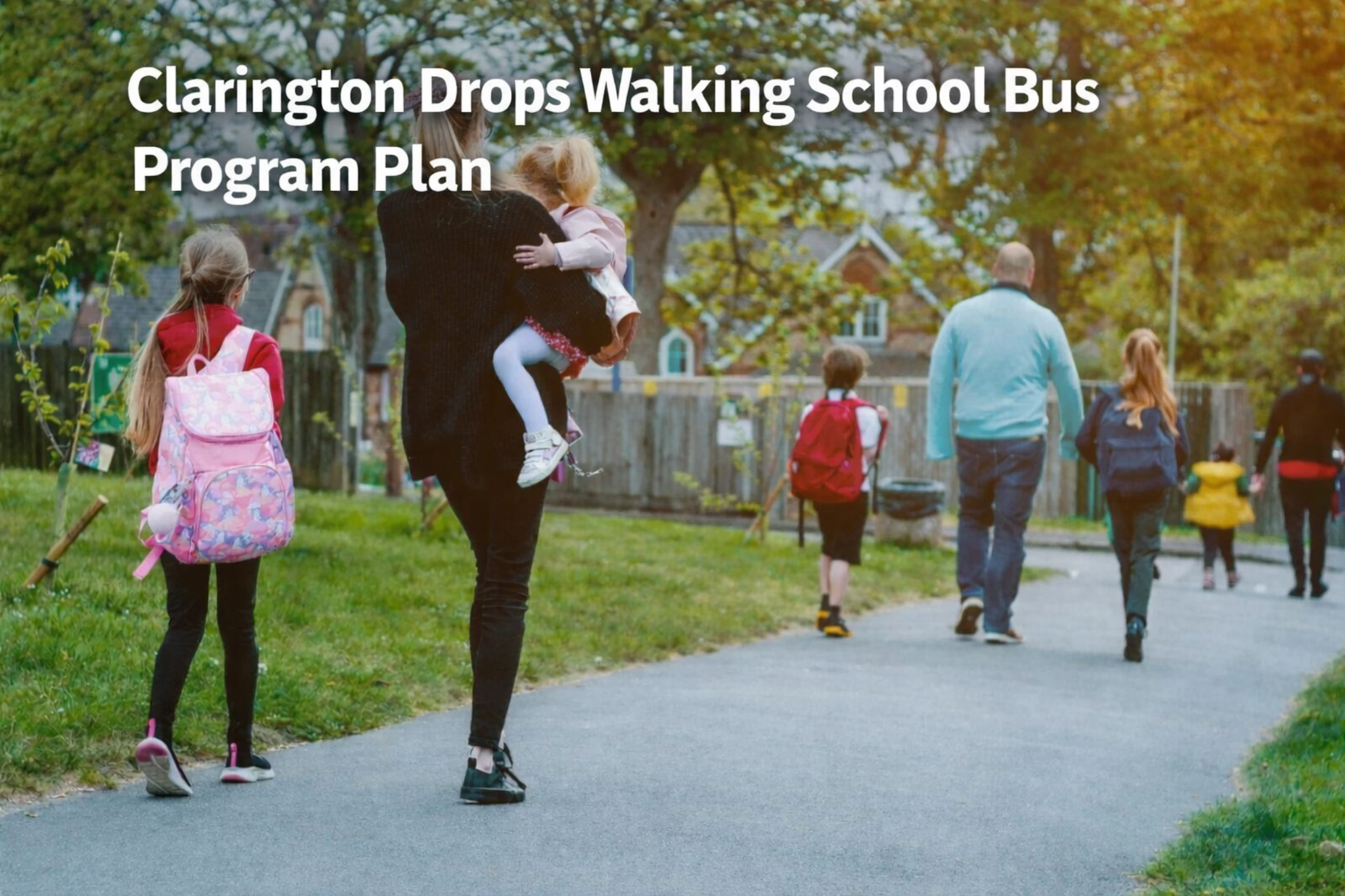
A proposal to introduce a walking school bus program in Clarington aimed at reducing school traffic congestion has been abandoned by municipal council after concerns were raised about liability, administration, and program management.
The idea was introduced by Councillor Corinna Traill during a general government committee meeting on March 2. Her motion asked municipal staff to explore the possibility of establishing walking school bus programs in partnership with the Canadian Cancer Society, which provides resources and frameworks to help communities organize volunteer-based walking groups for students.

Walking school bus programs typically involve groups of children walking to school together under the supervision of trained adult volunteers. The programs are designed to encourage physical activity, reduce vehicle congestion near schools, and improve safety for students travelling to school.

Coun. Traill explained that the Canadian Cancer Society already offers an established framework to support communities interested in implementing such initiatives.
“The heavy lifting as far as infrastructure is done, as the Canadian Cancer Society already has an established framework for administration,” Traill said. “The problem is there is none in Durham, which I thought was a shocking absence.”
The purpose of the motion, she explained, was to begin discussions and ensure that local school boards would be involved in planning the initiative from the early stages.
However, the proposal quickly met resistance from council members and education representatives.
Cathy Abraham, trustee for the Kawartha Pine Ridge District School Board, spoke during the meeting and expressed concerns about the proposal, particularly the suggestion of identifying specific schools as pilot locations.
“It’s not appropriate to name or ask schools to do a pilot,” Abraham said, adding that several questions about the program remained unanswered.
She raised concerns about how the program would operate and who would be responsible for coordinating volunteers, organizing schedules, and managing safety.
“How exactly does the municipality envision a walking school bus program working?” Abraham asked. “Who will administer the program, set up the schedules, find and organize the volunteers, and what is the liability of this?”
Abraham said she generally supports programs that encourage students to walk to school but suggested that the proposal needed further consultation with schools and school boards before moving forward.
Council members also acknowledged the growing traffic issues near schools throughout Clarington.
Rob Maciver, Deputy CAO and solicitor for Clarington, noted that traffic congestion around schools has become a serious concern.
“The roads aren’t designed to handle the traffic that’s coming to schools,” Maciver said. “The schools themselves aren’t designed to accept the amount of traffic flowing to them, and the resources available to enforce traffic rules are limited.”
While many councillors agreed that encouraging students to walk to school could help address these challenges, several said the potential risks associated with the program were too significant.
Councillor Sami Elhajjeh said liability concerns were a major factor in his opposition.
“The liability scares the bejeezus out of me,” Elhajjeh said. “It’s a lot of risk.”
Councillor Marg Zwart also expressed doubts about the program’s long-term sustainability, noting that a similar initiative in Orono years ago struggled to survive during winter months.
In the end, council voted to table the proposal entirely, effectively halting any further exploration of the walking school bus program.
However, officials noted that the motion could be reintroduced at a future council meeting if new ideas or solutions emerge to address the concerns raised during the debate.