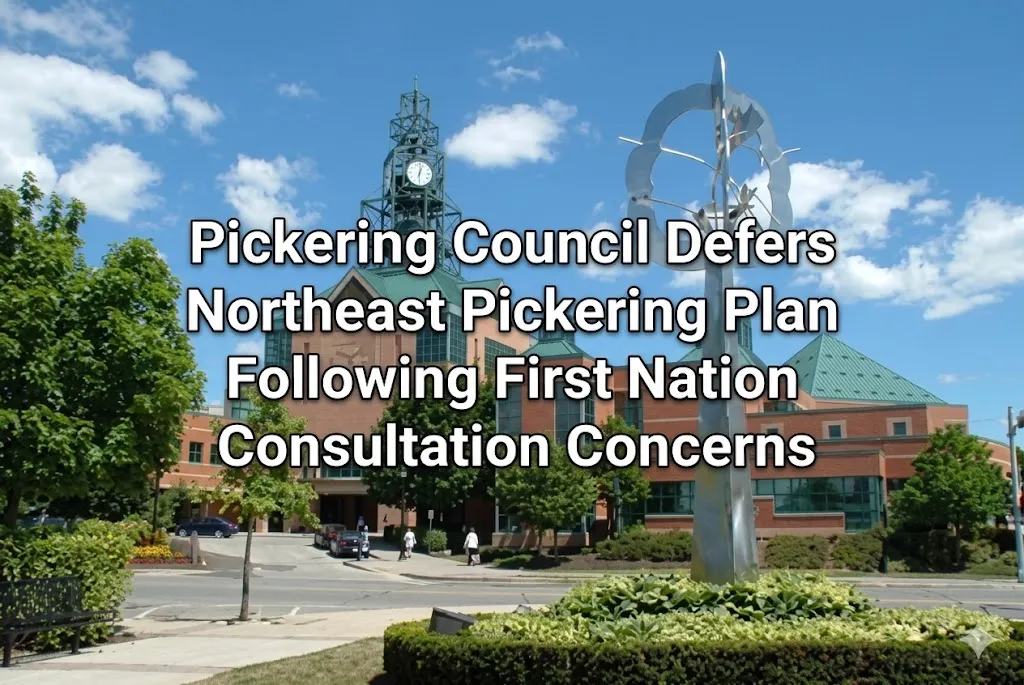
A pivotal decision on the future of North Pickering has been put on hold to allow for government-to-government dialogue. On April 10, 2026, the Mississaugas of Scugog Island First Nation (MSIFN) announced that the City of Pickering has deferred its decision on the controversial Northeast Pickering plan for at least one month. The delay comes after the MSIFN repeatedly raised concerns regarding a “complete lack of meaningful dialogue” and the bypassing of established consultation protocols.
The Consultation Conflict
In 2024, the City of Pickering and the MSIFN signed a formal Relationship Agreement. This document was intended to create a transparent framework for consulting the First Nation on the development of the Northeast Pickering Secondary Plan. However, MSIFN leadership stated this week that their requests to discuss significant concerns have been largely ignored by the city.


The deferral is intended to provide Mayor Kevin Ashe with a specific window to meet with the Chief and MSIFN Council members. “A consultation protocol between the City of Pickering and MSIFN is needed,” the First Nation’s statement read, emphasizing that the current process has failed to meet the standards of the 2024 agreement.


What is the Northeast Pickering Plan?
The plan represents one of the largest urban expansions in the Durham Region’s history. It covers approximately 1,720 hectares of primarily agricultural land, located outside of the Provincial Greenbelt. The city’s vision for the area includes:
-
Growth: Accommodating an estimated 70,000 to 72,000 new residents over the next 30 years.
-
Employment: Creating roughly 9,700 new jobs through high-density employment areas.
-
Boundaries: The land is bounded by Eighth Concession Road (north), Highway 7 (south), Westney Road (west), and Lake Ridge Road (east), marking the border between Pickering and Whitby.
Affordability vs. Stewardship
Pickering Council has championed the project as a necessary step to address the regional housing crisis and improve long-term affordability. By transforming these lands into high-density residential communities, the city aims to build a sustainable, “complete community” that includes modern infrastructure like new roads, fire stations, and parks.
Conversely, the MSIFN and environmental advocates have expressed caution regarding the scale of the development and its impact on the watershed and traditional territories. The First Nation has clarified that they are not necessarily against development but insist on “meaningful and legally required” consultation to ensure their treaty rights and environmental interests are respected.
As the one-month deferral begins, the focus shifts to the upcoming meeting between Mayor Ashe and MSIFN leadership. The outcome of these talks will likely determine whether the Northeast Pickering Secondary Plan proceeds as scheduled or faces further delays and potential legal challenges over consultation duties.