








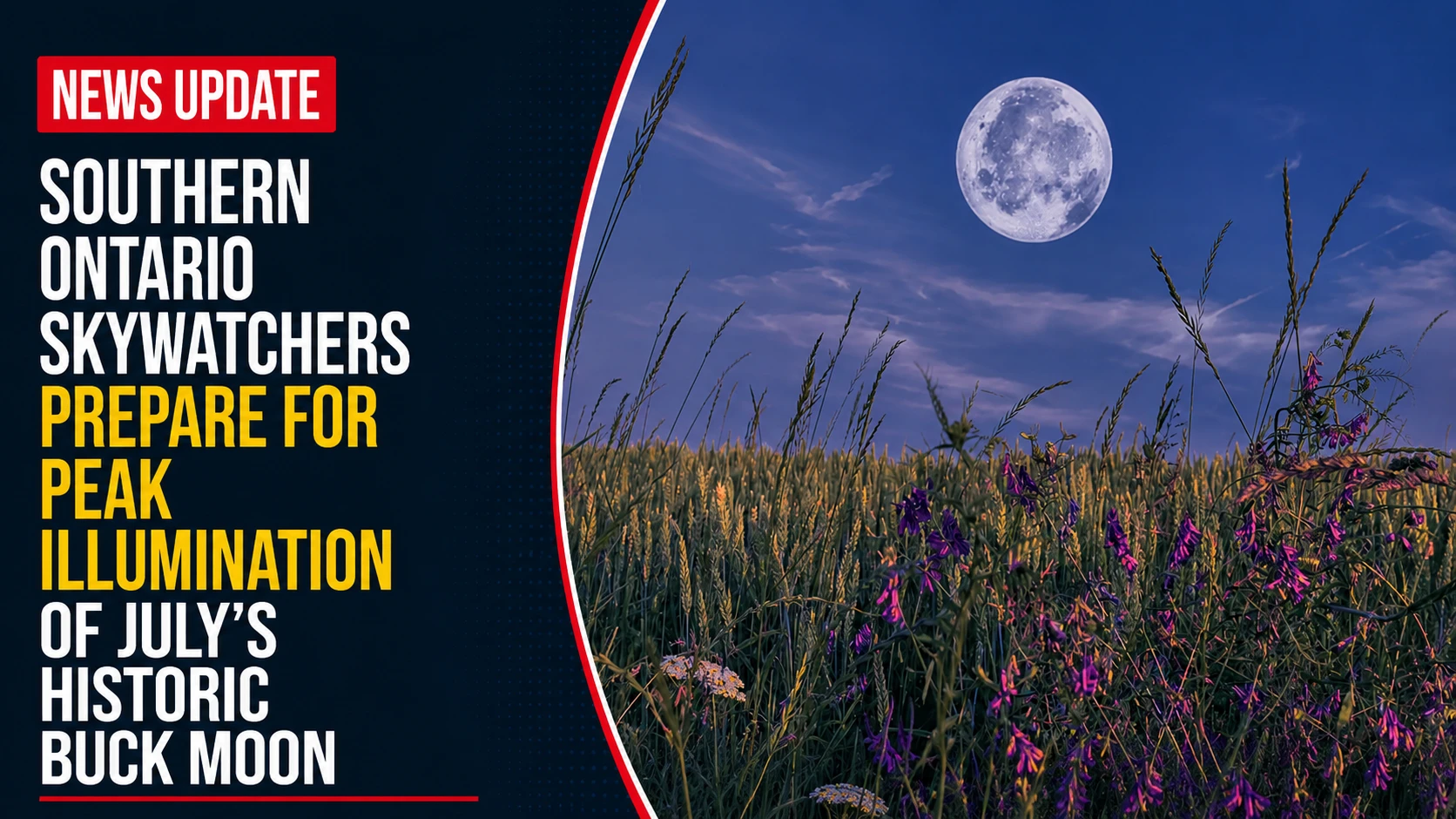
The regional science networks, planetarium monitoring groups, and amateur astronomy associations across Ontario are prepping their observation gear for a late-month celestial event. Tracked under provincial astronomical registries on Thursday, July 2, 2026, media specialists finalized the stargazing brief July’s ‘Buck Moon’ returns to Ontario this month. Marking the exact peak of the warm summer season, July’s full moon—traditionally known as the “Buck Moon”—will dominate the night sky, offering clear tracking opportunities for coastal and rural communities far removed from urban light pollution grids.
Because the maximum illumination phase occurs during bright daylight hours in North America, local space experts are directing residents to focus their observation sessions on specific evening twilight windows.


The Lunar Timeline and Multicultural Agricultural Heritage
The upcoming full moon carries rich historical data states, deeply tied to the seasonal harvests and wildlife tracking behaviors of various indigenous cultures.


-
Male Deer Velvet Antlers: The popular “Buck Moon” name, popularized by The Old Farmer’s Almanac, originates from early colonial and indigenous tracking of male deer (bucks), whose new velvet-coated antlers grow rapidly and progressively larger during the mid-summer months as a symbol of structural strength and renewal.
-
The Diverse Regional Roster: Different indigenous nations map the July moon phase according to localized changes in nature and weather. The Cree call it the Feather Moulting Moon, the Tlingit track it as the Salmon Moon, the Anishinaabe celebrate it as the Berry Moon or Halfway Summer Moon, and the Algonquin and Ojibwe identify it as the Raspberry Moon.
-
The Thunder Moon Variant: The Western Abenaki historically call this phase the Thunder Moon, pointing to the heavy convective storm cells and high humidity waves that regularly roll across southern Ontario during July.
Analyzing the July 2026 Lunar Phase and Activity Matrix
The monthly lunar tracking chart maps out distinct phases alongside optimized dates for traditional agricultural and fishing activities.
| Scheduled Lunar Phase Node | Exact Calendar Date | Peak Coordinated Time (EDT) | Recommended Seasonal Human Activity |
| Last Quarter Phase | Tuesday, July 7, 2026 | 3:29 p.m. Afternoon | Optimal window for cutting hay (July 6–8) |
| New Moon Phase | Tuesday, July 14, 2026 | 5:43 a.m. Dawn | Launch of peak summer fishing window |
| First Quarter Phase | Tuesday, July 21, 2026 | 7:05 a.m. Morning | Active fishing loops / Night sky scoping |
| Full Buck Moon Apex | Wednesday, July 29, 2026 | 10:36 a.m. Daylight | Setting agricultural poultry eggs |
Astronomers clarify that because the precise peak occurs at 10:36 a.m. when the moon is physically situated below the local Ontario horizon, stargazers should look toward the southeastern sky immediately after sunset on both Tuesday, July 28, and Wednesday, July 29. During these twilight hours, the famous “moon illusion” will take effect, making the low-hanging lunar disc appear massive and deep orange as it rises past distant treelines and structural horizons.
Local conservation groups are recommending that observers drive out to open dark-sky spots, like the Oak Ridges Moraine paths or the shores of Lake Scugog, to dodge city streetlights and capture the best views.
Durham region astronomers, back-country campers, and night-sky photographers looking to download real-time cloud tracking maps, check local horizon coordinate grids, or view historical astrophotography galleries can find full public resource files online at rasc.ca or weather.gc.ca.