




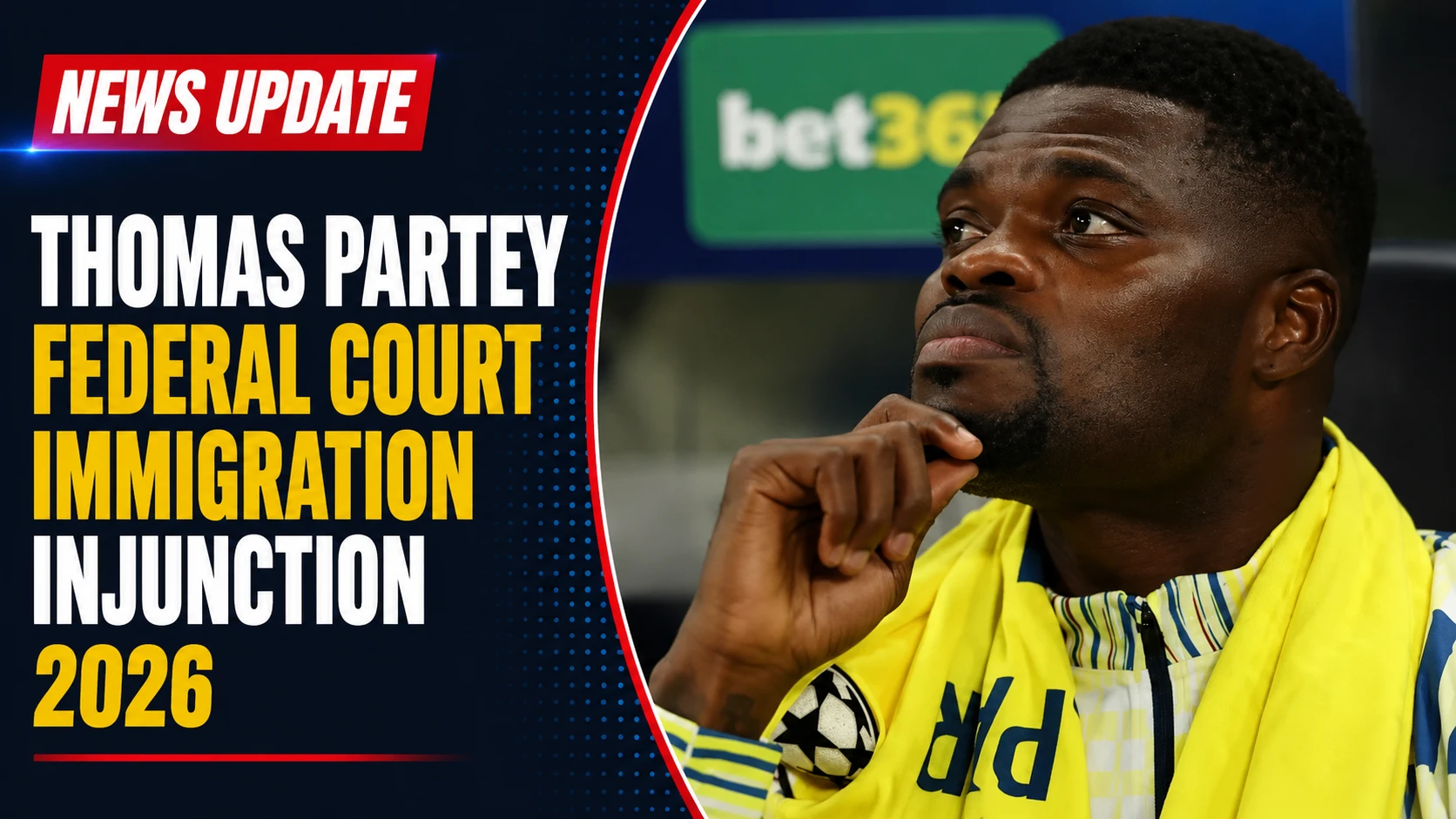
The international geopolitical and federal judicial framework governing the World Cup tournament has entered an unprecedented legal crisis following a strict border enforcement action. Tracked under the central public policy archive The Thomas Partey Federal Court Immigration Injunction 2026, federal court clerks and immigration lawyers initialized the emergency docket on Tuesday morning, June 16, 2026. The high-stakes legal challenge, spearheaded by the Ghanaian government, seeks an immediate judicial injunction to throw out Canada’s border refusal of 32-year-old star midfielder Thomas Partey, who was barred entry due to active criminal indictments in the United Kingdom.
Federal immigration authorities are holding a firm line, declaring that hosting a global sporting event does not grant automatic immunity or rewrite the nation’s strict border security laws.


The Legal Inadmissibility Matrix and Border Refusal
The emergency court action follows a border checkpoint shutdown that left the Ghanaian national football team missing one of its most prominent midfield assets right before their opening matches.


The underlying court filings detail a massive clash between international sports management and federal statutory laws:
-
The Travel Standoff: Following the sudden border refusal by immigration officers, the 32-year-old midfielder remains stranded in the United States, completely unable to join his teammates at their training camps ahead of Ghana’s opening match against Panama on Wednesday in Toronto.
-
The Serious Criminality Threshold: Under Canada’s active Immigration and Refugee Protection Act (IRPA), individuals awaiting trial for high-tier offenses face immediate borders bars. Partey is currently awaiting trial in England on five counts of rape involving two women and one count of sexual assault involving a third woman, with his defense lawyers stating intention to plead not guilty to two more pending counts.
-
The Case-by-Case Rule: The federal government has repeatedly clarified that international athletic status does not override domestic public safety screenings, emphasizing that all border entry permissions are evaluated under identical public criteria.
Tournament Capacity Adjustments and Security Measures
As the judicial review gets underway in Ottawa, the sudden border battle is forcing sports analysts and regional tourism coordinators to adjust their match expectations.
| Monitored Tournament Node | Active Legal / Athletic Status | Projected Roster Impact Profile | Strategic Regional Risk |
| Ghana National Team | Missing primary midfield anchor | Extreme tactical adjustment forced | Lowered competitive match margins |
| Federal Court Bench | Active Injunction Hearing | Could force border clearance | Precedent for future athletic entry |
| GTHA Security Sectors | High-alert transit protocols | Increased media and diplomatic crowd control | Heightened pressure on regional links |
The Ghanaian government’s legal team is pushing for a lightning-fast ruling from the judge to fly the athlete across the border before the opening whistle blows.
With the eyes of the global sports world locked on the Canadian legal system, federal prosecutors are fighting the injunction, arguing that bypassing normal immigration protocols undermines the integrity of national security enforcement.
Football fans and regional residents can monitor live updates on the injunction hearing, review official federal court dockets, or track evolving tournament schedules by exploring the centralized court database online at fct-cf.gc.ca.