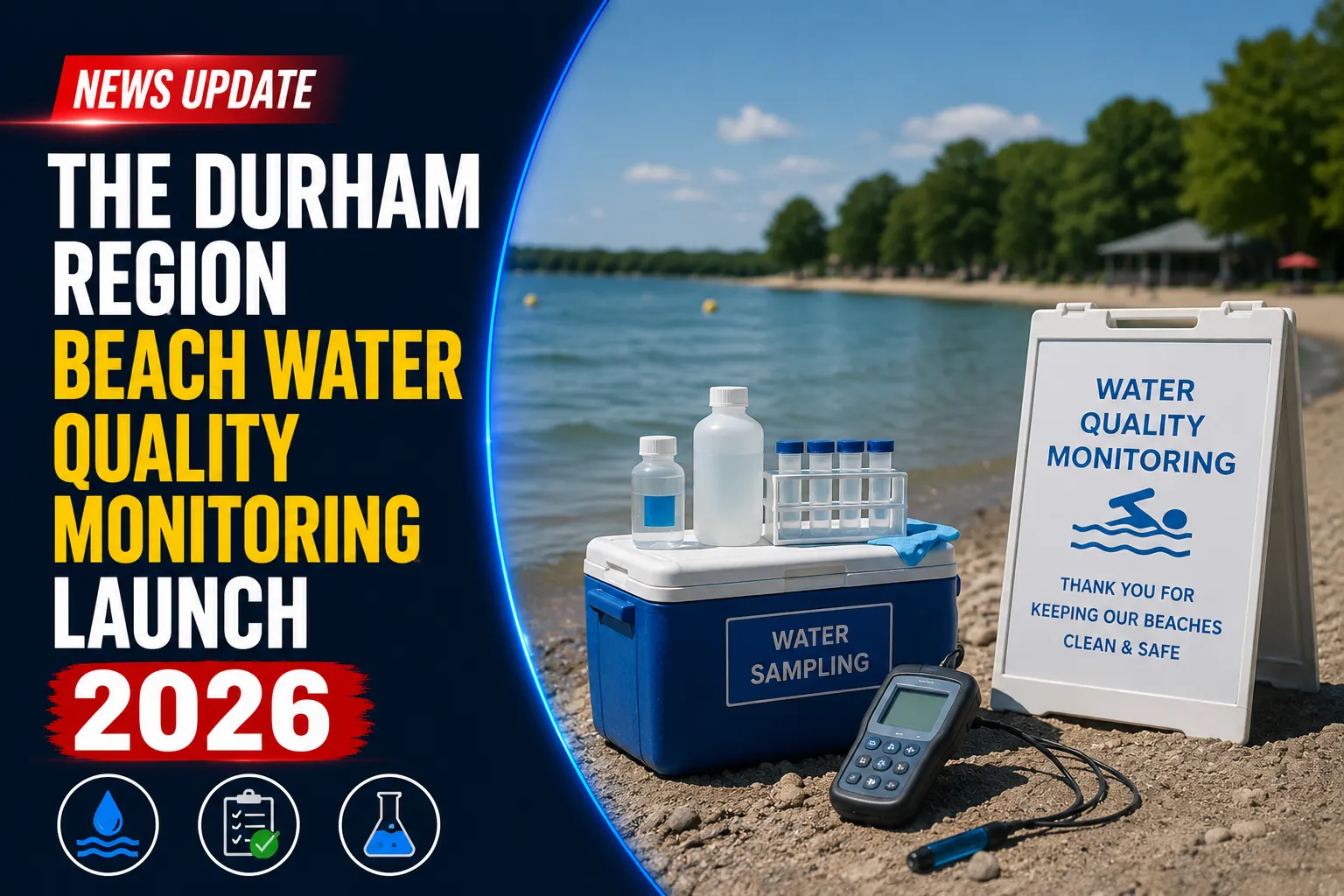
The Durham Region Health Department has finalized the operational rollout and lab logistics for its 2026 Beach Monitoring program, establishing a rigorous weekly testing loop to protect residents from waterborne pathogenetic vectors. Tracked under the central public safety folder The Durham Region Beach Water Quality Monitoring Launch 2026, municipal health inspectors published the season’s inaugural water sample datasets on Thursday, June 4, 2026. All raw inspection results have been integrated directly into Check&Go! Durham—the region’s centralized online public disclosure portal.
The seasonal environmental program will run continuously throughout the summer months, providing real-time data updates up until the conclusion of the Labour Day weekend.


The Anatomy of the Bacteriological Testing Matrix
The public health framework utilizes a highly structured collection and analysis pipeline to monitor fecal coliform counts at the region’s 15 primary public beaches. Field technicians gather weekly water samples from designated shoreline zones, immediately shipping the containment units to the Public Health Ontario Laboratory in Peterborough for detailed diagnostic incubation.


Environmental health officials use a strict mathematical safety standard to determine if a beach is safe for public swimming. A beach is instantly red-flagged and posted as unsafe for swimming when local Escherichia coli (E. coli) counts cross the rigid provincial threshold:
Sendi Struna, Manager of Health Protection with the Durham Region Health Department, emphasized that providing transparent, on-demand access to water safety results allows families to make confident, safe decisions before heading out to local waterfronts. To ensure maximum reach, public health teams will post automated digital reminders every Friday across the region’s official social media channels, including X (formerly Twitter), Instagram, and Facebook.
The Post-Precipitation Contamination Contingency
While weekly lab testing provides an accurate baseline, public health doctors warn that rapid weather changes can cause quick spikes in bacterial counts between standard testing intervals.
| Monitored Coastal System | Total Public Beach Assets | Primary Target Risk Vector | Public Information Channel |
| Lake Ontario Shoreline | 15 Inspected Public Spaces | Agricultural & Urban Run-Off | durham.ca/BeachResults |
| Lake Scugog / Simcoe | Integrated Northern Points | Post-Storm Bacterial Spikes | Check&Go! Durham Portal |
| Regional Inquiry Desk | Direct Municipal Access | General Program Logistics | myDurham 311 System |
Health inspectors urge beachgoers to completely avoid swimming at any public beach for at least 48 hours following heavy rainfall events.
During severe summer downpours, high-volume storm water flows over city roads, industrial properties, and rural farm fields, washing animal waste, fertilizers, and untreated debris straight into local swimming areas. This run-off can cause a dangerous, temporary surge in bacterial counts that can cause severe gastrointestinal illness or skin infections upon contact. Residents looking to check current beach conditions or report local water quality concerns can access the dynamic mapping registry at durham.ca/BeachResults or connect directly with regional dispatchers by dialing myDurham 311.