








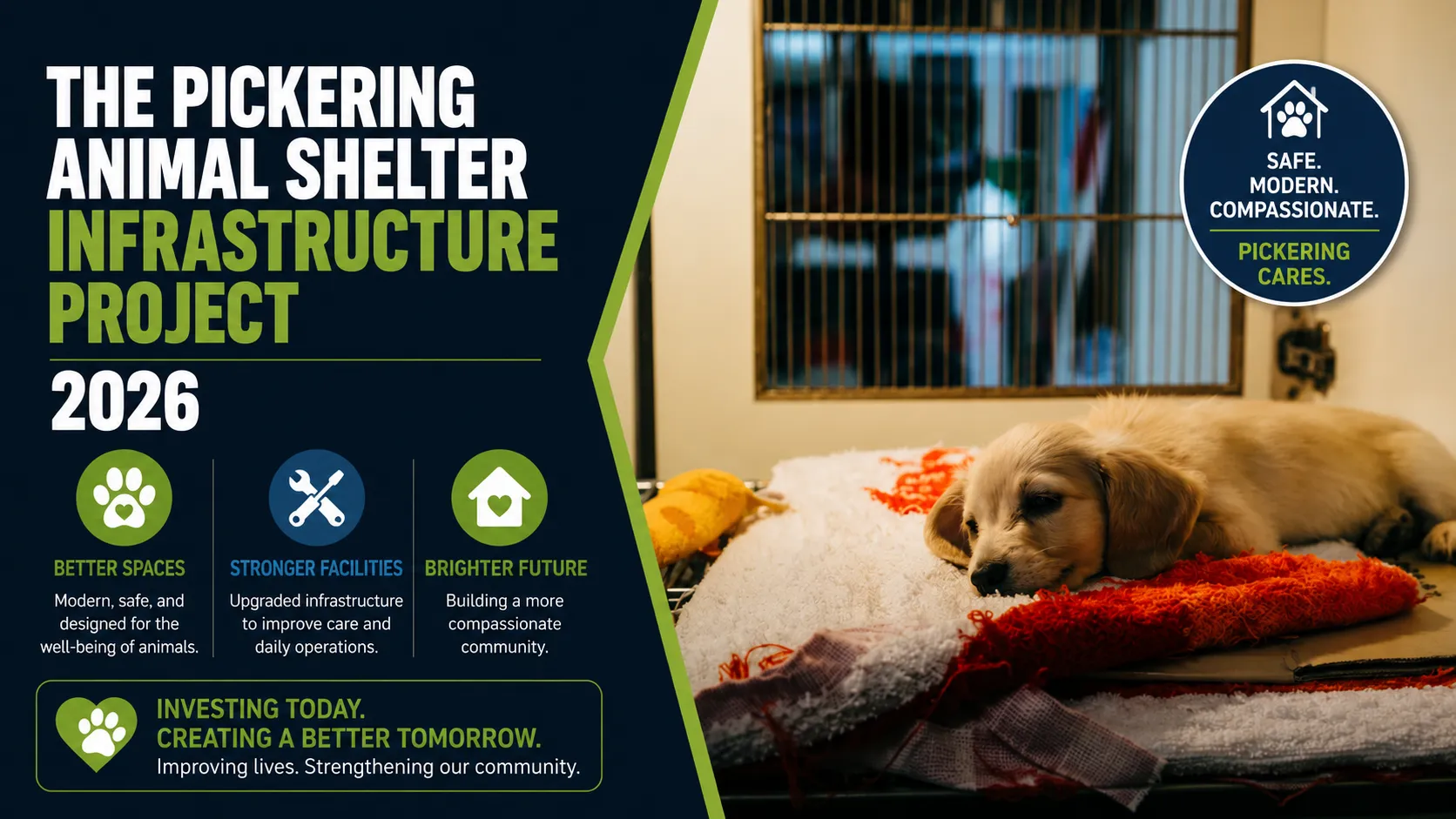
The City of Pickering is poised to authorize an immediate financial injection to transition its over-capacity animal services from a crumbling leased storefront into a state-of-the-art civic campus. Under the active legislative files tracking The Pickering Animal Shelter Infrastructure Project 2026, lawmakers are evaluating a specialized consulting proposal submitted by Unity Design Studio. The comprehensive architectural blueprint carries a gross project design cost of $1,506,999 (including full HST), engineering a centralized headquarters that combines advanced shelter care with the city’s Municipal Law Enforcement Services (MLES) division.
The funding push stems from severe physical bottlenecks inside the current facility, which staff warn routinely compromises both operational animal welfare standards and employee workspace safety.


The Architecture of the 3.2-Acre Net-Zero Campus
The proposed construction node shifts operations onto a 3.2-acre block of city-owned land directly west of Pickering Fire Station 1 and Headquarters, situated at 1700 Zents Drive (the northwest corner of Zents Drive and Brock Road). This central node was selected to significantly decrease emergency service response timelines across the northern and southern urban sectors.


To prevent the construction from drawing down from general property tax levies, Pickering’s Director of Finance has engineered a tri-stream funding model to clear the $1,357,099 net HST framework:
-
Development Charges ($284,061): Pulled directly from the DC Protective Services Reserve Fund, generated by ongoing regional population growth.
-
Animal Shelter Reserve ($784,754): Extracted from dedicated internal asset pools reserved exclusively for animal infrastructure updates.
-
Casino Revenue Fund ($288,284): Diverted from the city’s standard local gaming hosting revenues to offset remaining capital requirements.
Architectural parameters mandate that the new building satisfy strict Net Zero Carbon – Design Standard (ZCB – Design) criteria governed by the Canada Green Building Council (CaGBC). Preliminary site concepts have already cleared initial reviews with the Toronto and Region Conservation Authority (TRCA), ensuring that the surrounding forested wetlands remain unaffected while serving as a natural sound barrier to shield adjacent residential neighborhoods from barking kennels.
Decommissioning the Highway 7 Leased Boundary
The urgent push for the Zents Drive development follows a scathing staff breakdown of the existing shelter located at 1688 Highway 7 in Brougham. Occupying a cramped lease footprint of less than 2,800 square feet, the aging structure suffers from deteriorating infrastructure, zero parking expansion room, and a total inability to meet modern veterinary isolation guidelines.
| Operational Parameter | Deficient Brougham Lease (Highway 7) | Upcoming Zents Drive Campus Profile |
| Physical Footprint | Less than 2,800 square feet (cramped) | 3.2-Acre Custom-Built Complex Node |
| Canine Capacity | Max 6 dogs (Quarantine capped at 2) | Expanded Capacity for Care standard lines |
| Feline Housing | Combined Stray/Adoption rooms (High risk) | 44 Cats with separate health-status rooms |
| Exotic/Bird Care | Cages stacked on open hallway tables | Sound-isolated, public-free enrichment zones |
| Outdoor Security | Dangerous/Quarantined dogs locked indoors | Secure, separated open-air exercise paddocks |
The structural deficiencies are particularly acute within the canine units. The Brougham site safely accommodates only six dogs. When the population spikes past this baseline, staff can no longer utilize internal guillotine isolation doors to clean cages safely, exposing handlers to physical risk and accelerating disease vector transmission. Furthermore, the quarantine wing can hold only two animals; additional dangerous or sick dogs must be farmed out to external private kennels at significant taxpayer expense.
By integrating the Capacity for Care model backed by the Association of Shelter Veterinarians, the new build will feature strict physical separation based on health status, age, gender, and predator-prey dynamics. The facility will establish dedicated rooms for intake, medical examinations, adoptions, isolation, and laundry, while providing safe, secure outdoor tracks where even quarantined or dangerous animals can access open air without risking public safety.