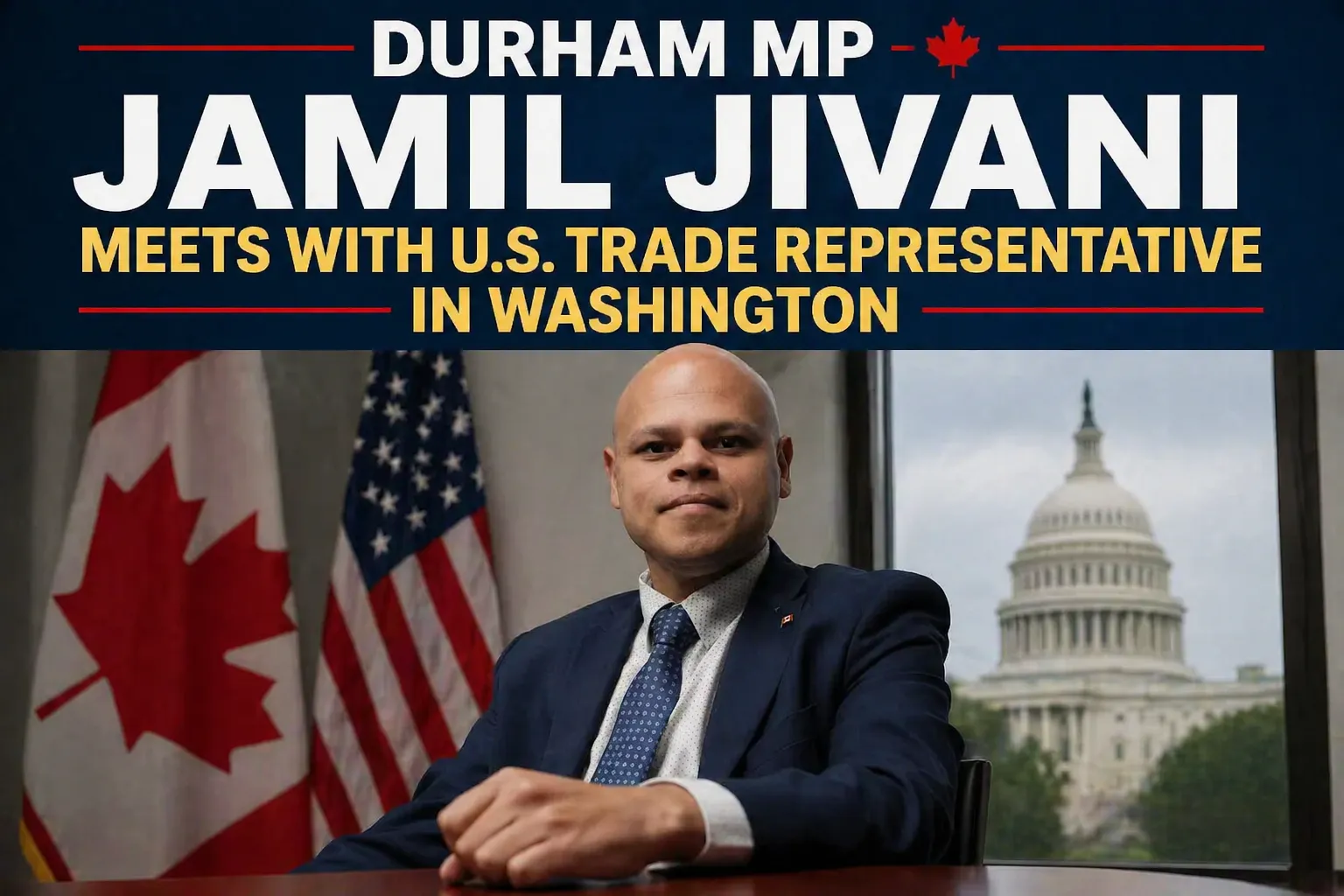
In a move that continues to draw both national and international attention, Durham MP Jamil Jivani has returned to Washington, D.C., for high-level trade discussions. As of today, April 29, 2026, Jivani is meeting with United States Trade Representative Jamieson Greer and various Canadian business stakeholders. The Canadian Embassy has confirmed its presence at the meeting, signaling the official nature of the talks despite a complex political backdrop in Ottawa. Jivani has stated that his primary goal is to support efforts to secure a favorable trade deal between the Trump administration and the Canadian government under Prime Minister Mark Carney.
This visit follows a controversial trip earlier this year where Jivani met with his longtime friend, Vice-President JD Vance, and had a brief encounter with President Donald Trump at the White House. While Durham MP Jamil Jivani frames these visits as essential bridge-building for Canadian economic interests—particularly regarding tariff-free trade—his actions have sparked friction within his own party. Conservative Leader Pierre Poilievre has publicly distanced the party from Jivani’s solo diplomatic efforts, reiterating that the MP speaks only for himself and not on behalf of the Conservative caucus.


The tension between Jivani and party leadership adds a unique layer to the Durham MP Jamil Jivani diplomatic mission. While Poilievre recently completed his own tour of the United States, he pointedly did not visit Washington or meet with Trump administration officials. Despite this, Jivani remains steadfast in his belief that direct engagement with the U.S. Trade Representative is vital for Ontario’s business interests. Greer, the U.S. Trade Rep, is a key figure in the upcoming renegotiations of North American trade agreements, making Jivani’s access to him potentially significant for Durham’s manufacturing and agricultural sectors.


Local reaction in the Durham riding has been mixed. Some constituents view Jivani’s high-level American connections as an asset that ensures the region’s voice is heard at the highest levels of international trade. Others, however, share Poilievre’s concerns regarding the consistency of the party’s message and the optics of a backbench MP conducting “rogue” diplomacy. Jivani has maintained that he is “fighting for the workers of Durham” by ensuring that potential tariffs do not disrupt the cross-border supply chains that are the lifeblood of the Oshawa and Clarington economies.
As the meetings in Washington conclude, the political fallout in Canada is expected to continue. Prime Minister Mark Carney’s office has not yet officially commented on Jivani’s offer to contribute to federal trade negotiations, though the presence of embassy officials suggests a level of cautious cooperation. For Durham MP Jamil Jivani, this trip reinforces his position as a unique, if polarizing, figure in Canadian-American relations—one who is willing to leverage personal friendships with the U.S. executive branch to influence domestic policy and regional economic outcomes in 2026.