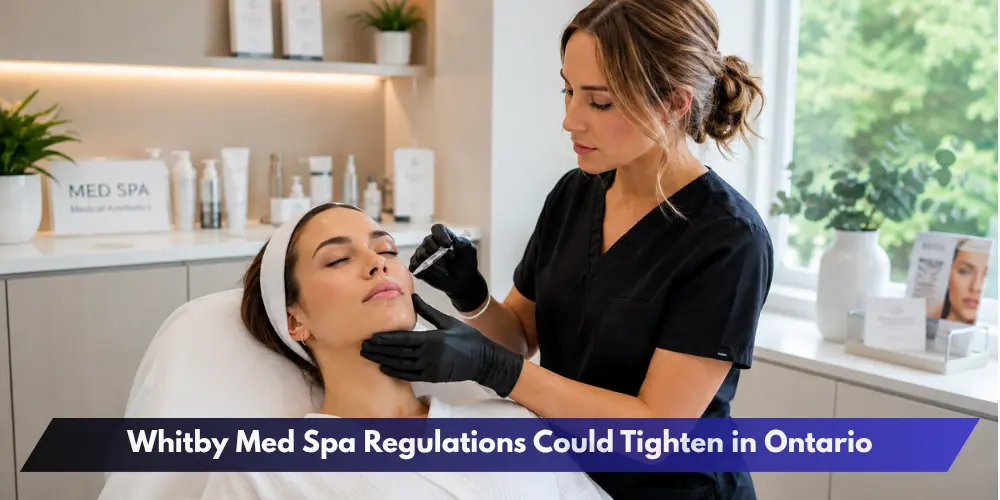
Whitby Med Spa Regulations could face changes as Ontario’s nursing regulator strengthens oversight of nurses providing Botox, dermal fillers and other medical aesthetic procedures.
The College of Nurses of Ontario has introduced new guidance aimed at improving patient safety and transparency in the rapidly growing medical aesthetics industry.


The rules have a Durham Region connection through registered nurse Hilary Thiessen, who operates cosmetic clinics in Toronto and Whitby and has raised concerns about how additional restrictions could affect both regulated providers and patients.


New guidelines clarify professional responsibilities
The College of Nurses of Ontario released its new Aesthetic Services practice guideline in July.
It applies to nurses providing cosmetic procedures including neuromodulator injections such as Botox, dermal fillers, thread lifts, platelet-rich plasma and microneedling.
The regulator says aesthetic treatments carry many of the same risks as other medical procedures, including infection, pain and potentially serious complications.
Nurses are expected to have appropriate education, training and competence while following infection-control practices and ensuring patients understand and consent to treatments.
Professional titles must be clear
Another concern involves how practitioners describe themselves to patients.
Terms such as “master injector” or “head esthetician” can create confusion about someone’s actual professional qualifications.
The new guidance emphasizes nurses’ professional accountability and transparency so patients can understand who is providing their treatment and what qualifications they hold.
Ontario residents can also verify whether someone is registered as a nurse through the College’s public register.
Delegation rules under review
The regulator is also reviewing broader rules involving delegation and authorization of controlled acts.
The College recently consulted nurses and other stakeholders about proposed changes, including requirements involving delegation and direct orders for drugs and controlled procedures in aesthetic settings. Those proposals are expected to be considered by the College’s council in September.
The supplied report says one proposed change would require a nurse who delegates certain aesthetic procedures to be physically present to supervise.
Such a change would target arrangements where medical directors oversee treatments remotely while other practitioners perform injections.
Whitby clinic operator raises concern
The Whitby Med Spa Regulations debate could have practical implications for local cosmetic clinics.
Thiessen, who operates clinics in Whitby and Toronto, said she supports stronger oversight but warned that an on-site supervision requirement could increase operating costs.
She argued that regulated clinics following stricter rules could potentially face higher expenses, which might influence prices charged to patients.
At the same time, she stressed that her clinics already follow practices outlined in the new nursing guidance.
Patients encouraged to ask questions
The College advises people considering aesthetic treatments to ask about a provider’s training, experience and ability to manage complications.
Patients should also understand who is authorizing a procedure when prescription medications or controlled acts are involved.
The CNO says the authorizing physician or nurse practitioner should be actively involved and reasonably accessible.
Patients can ask who will actually perform the procedure and whether that person is a regulated nurse or an unregulated care provider.
Further regulatory decision expected
The Whitby Med Spa Regulations discussion remains active because the proposed delegation changes have not yet been finalized.
The College’s existing aesthetic guideline is already in place, while additional amendments remain under consideration.
Any September decision could affect how Ontario med spas structure supervision, delegation and medical-director arrangements.
For Whitby patients considering Botox, fillers or similar treatments, the key advice remains to verify professional credentials, ask who is authorizing and performing the procedure, and understand how complications would be handled before agreeing to treatment.