








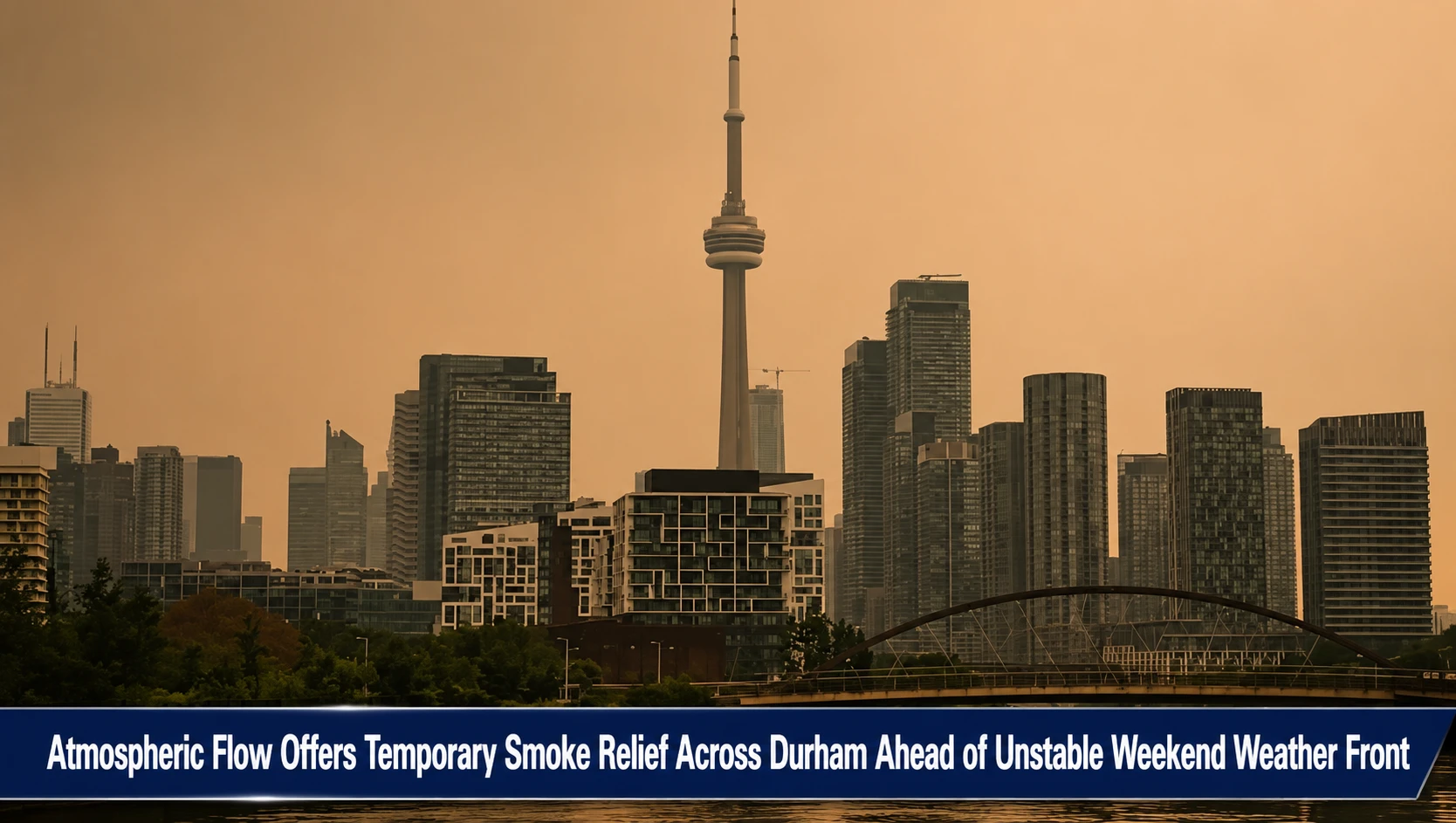
The emergency operations branches, regional environmental health panels, and public protection desks within the Durham Region are updating localized air quality monitoring logs. Tracked under provincial emergency management, wilderness fire suppression grids, and public health risk portfolios on Friday, July 17, 2026, disaster mitigation analysts finalized the high-priority overview Ontario could see relief from wildfire smoke as blazes continue across north. While Environment and Climate Change Canada forecasts a brief, highly anticipated window of atmospheric relief as shifting wind vectors begin to disperse the thick gray haze, safety analysts warn that particulate concentrations could easily fluctuate or rebound as intense out-of-control blazes sweep through northern timber blocks.
Federal and provincial authorities emphasize that because the massive smoke fields continue to cross international borders and impact domestic infrastructure, residents must remain vigilant and protect indoor air basins.


The Inter-Provincial Containment Grid and Evolving Wilderness Ignition Metrics
The wilderness emergency has triggered a multi-jurisdictional defense grid as northern fire counts hit critical seasonal peaks:


-
The Active Northwestern Burn Index: Forestry operations divisions confirm there are now 136 active wildfires burning across the northwest region, with a high-stakes subset of 63 blazes tracked as entirely out of control.
-
The Northeast Expansion Line: Compounding the western crisis, an additional 44 active forest fires are burning through dry fuel beds across the northeastern sector of the province.
-
The Call for Immediate Intervention: Following the structural destruction of the Namaygoosisagagun First Nation (Collins First Nation) north of Thunder Bay, both the Ontario government and the Assembly of First Nations have issued joint demands for immediate emergency assets. Mutual aid support—including specialized water bombers and tactical crews deployed from Alberta—remains active on the frontlines.
-
The Prime Minister’s Directive: Prime Minister Mark Carney formally confirmed that the federal government is maintaining tight communications loops with its Ontario counterparts, pledging that all necessary federal resources stand ready to protect isolated northern families and reinforce exhausted provincial crews.
Analyzing the Wildfire Smoke Exposure Symptoms and Domestic Air Filtration Protocols
Public health units have updated the specific physiological symptoms linked to fine wood ash inhalation alongside mandatory residential defensive steps.
| Documented Smoke Exposure Symptoms: Mild | Documented Smoke Exposure Symptoms: Severe | High-Priority Vulnerable Demographics | Recommended Domestic Air Protection Actions |
|
• Acute eye irritation and watering. • Nasal cavity burning sensations. • Dry, scratchy throat soreness. • Low-grade persistent headaches. • Mild, non-productive cough. |
• Acute, audibly high wheezing. • Sharp, localized chest pains. • Deep, uncontrollable coughing fits. • Immediate respiratory distress. |
• Senior citizens aged 65 and older. • Pregnant individuals. • Infants, toddlers, and young children. • Individuals with chronic lung/heart diseases. • Frontline outdoor industrial laborers. |
Seal Residential Structures: Keep all windows and doors closed tightly during dense haze periods. |
| Action: Transition instantly to indoor spaces. | Action: Seek immediate emergency medical aid. | Action: Minimize or halt all outdoor activity. | Upgrade Ventilation Media: Install the highest-quality mechanical air filters your home HVAC system can handle; deploy certified portable HEPA air cleaners. |
The National Security and Environmental Health Directives
“People more likely to be impacted by wildfire smoke should avoid strenuous activities outdoors and seek medical attention if experiencing symptoms,” Environment Canada stressed within its updated national safety brief. Local emergency planning leads note that when an extreme heat wave overlaps with a dense particulate smoke event, residents must prioritize remaining physically cool while keeping their home’s air supply completely sealed. Because the microscopic soot particles easily bypass standard human upper-respiratory systems, relying on simple cloth coverings is insufficient during peak ground-level smoke waves. Durham families are encouraged to run clean indoor fans, monitor regional air index updates, and ensure that air-purifying systems are set to continuous recirculation to successfully manage internal air quality until stable weather patterns arrive.
The Aviation, Forest Fire and Emergency Services Branch of Ontario, the Health Canada Environmental Health Directorate, and the Durham Region Emergency Operations Command Center handle ongoing blaze mapping, air quality metrics logging, and regional public shelter coordination.
Durham families, industrial operations managers, and regional travelers looking to track live satellite particulate dispersion loops for Oshawa and Whitby, view current active fire counts via provincial data feeds, or access resources for localized residential air filtration setups can find the tools online through the central Government of Canada environmental tracking portal at www.weather.gc.ca, review fire updates via the Ontario Ministry of Natural Resources portal, or monitor regional health alerts through the Durham Region public safety hub.