









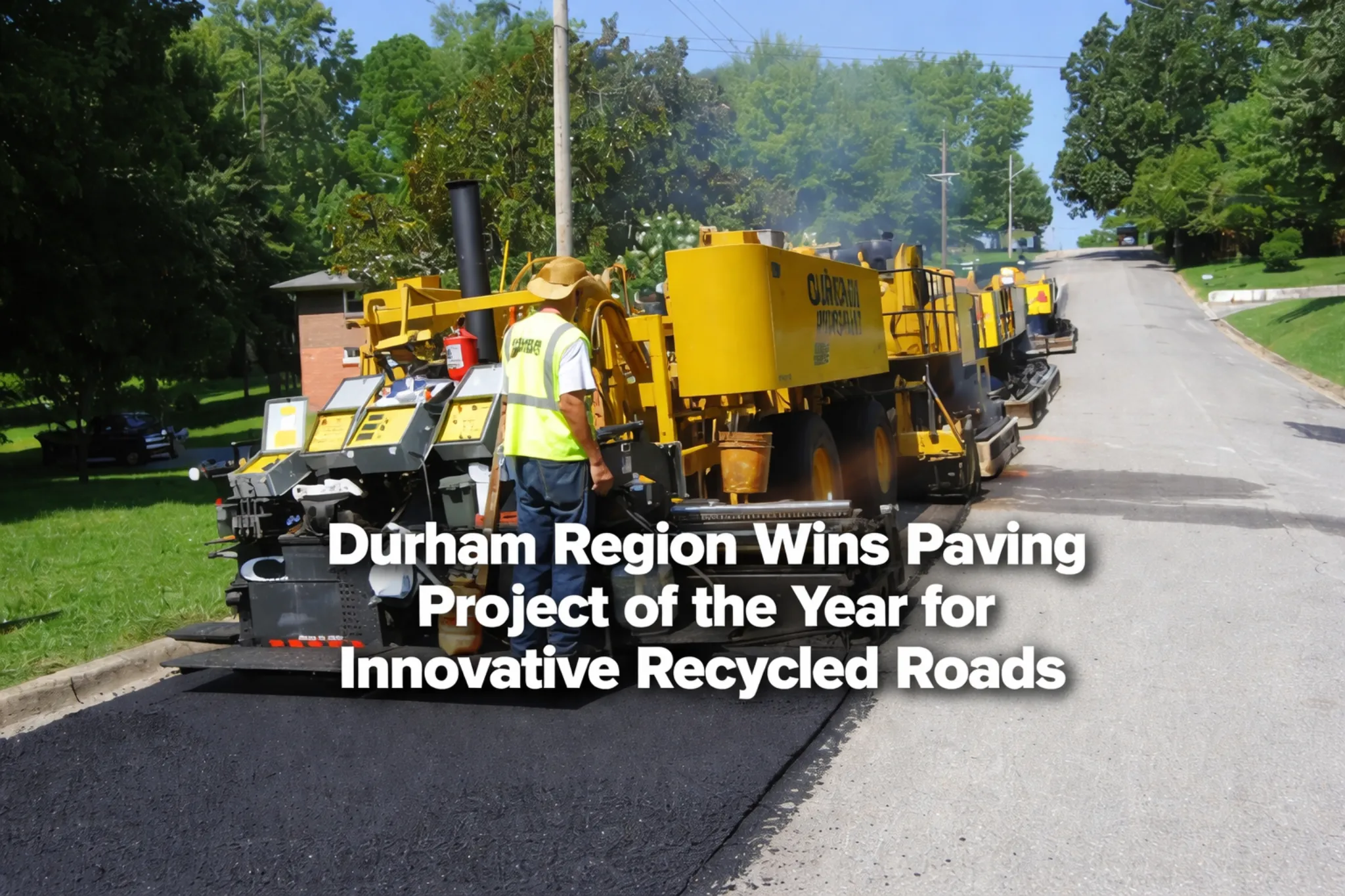
Durham Region is being celebrated as a provincial leader in sustainable infrastructure after securing the “Municipal Paving Project of the Year” award at the 2026 Ontario Good Roads Conference. The honor recognizes an innovative paving technology known as Hot-In-Place Recycling (HIR), which has allowed the Region to rehabilitate high-traffic corridors while significantly slashing both costs and carbon emissions.
Testing the Limits of HIR Technology
The award-winning pilot project was designed to test whether HIR could repair asphalt and extend road life under “real-world” Canadian conditions, which include punishing freeze-thaw cycles. The process uses specialized machinery to heat the existing road surface, mix it with a rejuvenating agent, and relay it immediately—creating a monolithic bond that resists potholes and water infiltration better than traditional methods.



The pilot initially targeted two challenging segments:
-
Scugog: Four kilometres of Shirley Road (Regional Road 19).
-
Clarington: 4.2 kilometres of Highway 2.
“Durham Region continues to adopt and test new technologies like HIR to learn what works best… to reduce our carbon footprint and meet our climate goals,” said Dan Waechter, Durham Region’s Director of Capital Projects Delivery. The results were so efficient that the Region realized a 33% cost savings compared to traditional “mill and overlay” methods.
Efficiency Leads to Bonus Repairs
Because the initial phases of the innovative paving technology pilot came in under budget, the Region was able to expand the contract to include additional locations that were not in the original plan. This included a 2.2-kilometre stretch of Lake Ridge Road in Brock Township and the parking facilities at the Waste Management Centre in Whitby.
A major breakthrough for this project was the addition of a one-metre shoulder widening using oxidized crushed Recycled Asphalt Pavement (RAP)—the first time this specific technique has been utilized in an Ontario paving project. This allowed crews to improve road safety without the need for mining and trucking in new aggregate materials.
A Win for Taxpayers and the Environment
Beyond the technical success, the HIR method offered immediate benefits to local motorists. Because the recycling happens entirely on-site, the “paving train” moves faster than traditional construction crews, resulting in significantly less traffic disruption for residents in Oshawa, Whitby, and Ajax.
Oshawa Regional Councillor Tito-Dante Marimpietri, who sits on the Works Committee, praised the team’s commitment to excellence. “The recognition for their innovative environmental pilot partnership… is a testament to their leadership and expertise,” Marimpietri stated. By generating zero waste and fully recovering all existing aggregates and asphalt, Durham has set a new standard for how municipal roads can be maintained.
The success of this pilot means that HIR is likely to become a permanent fixture in the Region’s long-term road rehabilitation strategy. As Durham grows, this innovative paving technology ensures that local infrastructure can be maintained sustainably, keeping the “bottom line” healthy while protecting the local environment.