







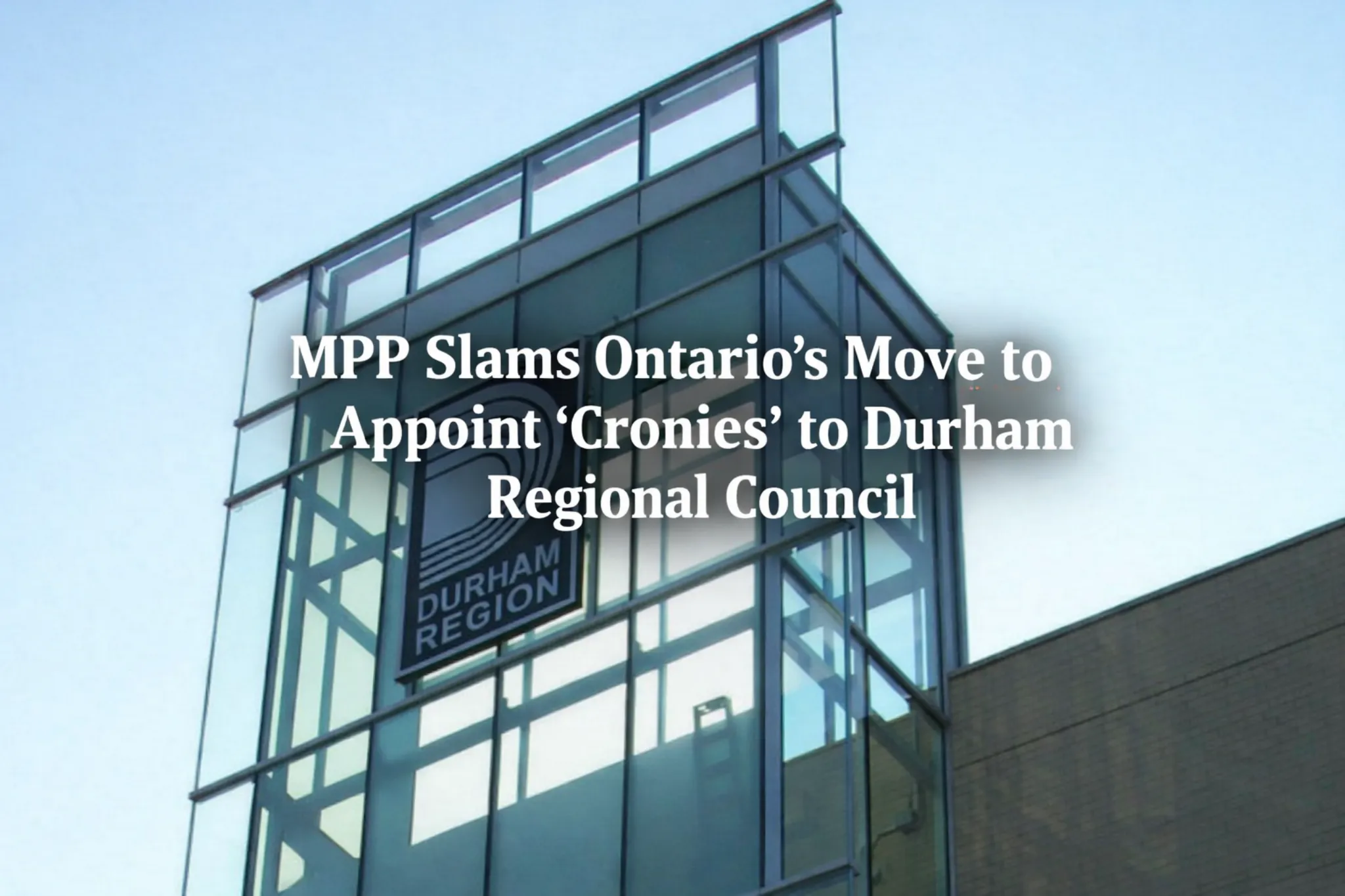
The debate over the future of local democracy in the Durham Region has intensified following a sharp critique from Ajax MPP and Ontario Liberal Critic Rob Cerjanec. Responding to the Ford government’s newly introduced Better Regional Governance Act, 2026, Cerjanec accused the province of “installing cronies” to lead regional councils, effectively stripping taxpayers of their right to choose their own leadership.
The Fight for Accountability in Durham
The legislation in question marks a historic shift in how Oshawa, Whitby, and Ajax are governed. Currently, the Regional Chair of Durham is an elected position, chosen directly by the voters. Under the proposed Act, this democratic process would be eliminated in favor of a direct appointment by the Minister of Municipal Affairs and Housing.



Cerjanec argues that regional municipalities are the backbone of local service delivery, funded primarily by property taxpayers. He maintains that for these institutions to remain accountable, the Regional Council chair must either be directly elected or selected by their elected peers, rather than hand-picked by Queen’s Park. “Installing their cronies to run regional councils is not a serious conversation,” Cerjanec stated, highlighting the growing tension between local representatives and the provincial government.
Provincial Overreach vs. Efficiency
The provincial government defends the move as a necessary step to “speed up decision-making” and align municipal actions with provincial priorities, such as the ongoing housing crisis. By granting these appointed chairs “strong chair powers,” the province aims to create a streamlined leadership model that mirrors the “strong mayor” system.
However, critics like Cerjanec view this as a “top-down” approach that ignores the specific needs of residents in Pickering, Clarington, and Uxbridge. Instead of appointing loyalists, Cerjanec suggests that the province should focus on a formal, decadal review of regional governance that is informed by local input. He also challenged the province to take back the costs of services that were previously “dumped” on municipalities if they truly want to reduce the burden on property taxpayers.
The Impact on Durham Taxpayers
The move has left many in the Durham Region questioning the future of their local representation. If the head of the Regional Council is beholden to the province rather than the local electorate, there are fears that regional interests—such as local transit, infrastructure, and social services—may be sidelined in favor of the province’s broader political agenda.
As the Better Regional Governance Act moves through the legislature, the outcry from local MPPs and community leaders continues to grow. Residents in Scugog and Brock are being encouraged to voice their concerns as the April 2026 deadline for municipal election nominations approaches, with many viewing this as a defining moment for the autonomy of the Durham Region.