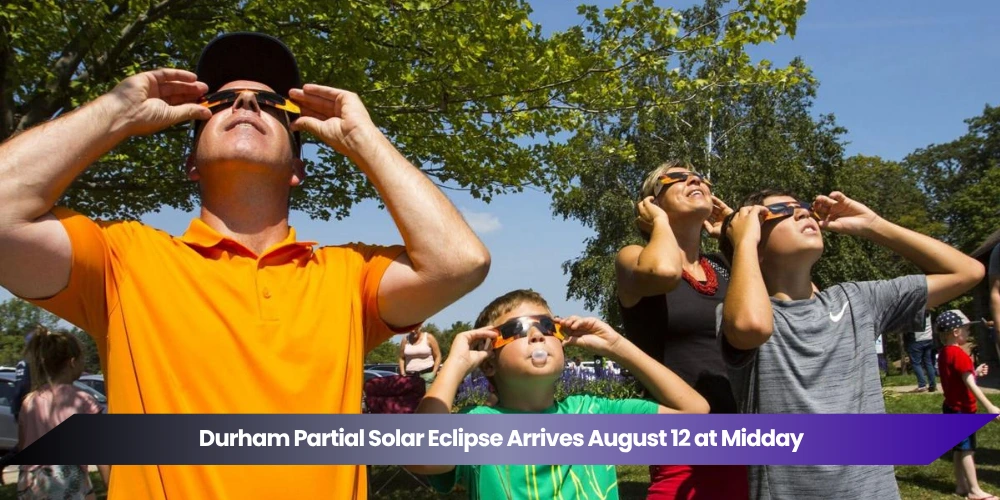
The Durham partial solar eclipse will give residents a chance to watch the Moon move across part of the Sun during the middle of the day on Wednesday, August 12, 2026.
The astronomical event will be visible throughout much of Canada, including Oshawa, Pickering and communities across Durham Region.

Durham will not experience a total solar eclipse. Instead, residents will see the Moon cover only a relatively small portion of the Sun.


NASA says the path of totality will cross Greenland, Iceland, northern Russia, the Atlantic Ocean, Spain and a small portion of Portugal, while much of Canada will experience a partial eclipse.
Durham Partial Solar Eclipse Viewing Times
The eclipse will begin shortly before 1 p.m. across southern Durham Region.
In Oshawa, calculations show the partial eclipse beginning at approximately 12:54 p.m.
Maximum eclipse will occur around 1:40 p.m., before the event ends at approximately 2:25 p.m.
The entire eclipse will last about one hour and 31 minutes.
Pickering will have nearly identical timing, with the eclipse beginning at approximately 12:54 p.m., reaching maximum at 1:40 p.m. and ending around 2:24 p.m.
Residents in Ajax, Whitby, Clarington and surrounding Durham communities can expect similar viewing times.
Actual visibility will depend on cloud cover, so skywatchers should check the local weather forecast closer to August 12.
Eclipse Glasses Required Throughout Event
Anyone planning to look directly at the Sun must use proper solar-viewing protection.
The Canadian Space Agency warns that regular sunglasses do not provide enough protection for viewing an eclipse.
Because Durham Region will experience only a partial solar eclipse, there will be no safe period when eclipse glasses can be removed while looking directly at the Sun.
Solar-viewing glasses should meet the ISO 12312-2 international safety standard and should be inspected before use.
Do not use glasses that are scratched, punctured, torn or otherwise damaged.
People without suitable eclipse glasses can use an indirect viewing method such as a pinhole or eclipse projector.
Cameras, binoculars and telescopes also require appropriate solar filters mounted over the front of the equipment. Looking through magnifying optical equipment without a properly installed solar filter can cause serious eye damage.
What Causes a Partial Solar Eclipse?
A solar eclipse happens when the Moon moves between Earth and the Sun.
During a total eclipse, the Moon completely blocks the visible surface of the Sun for observers within the narrow path of totality.
During a partial eclipse, the alignment is different for the observer and only part of the Sun appears covered.
That is what residents will experience during the Durham partial solar eclipse on August 12.
The eclipse will also arrive during an active week for astronomy enthusiasts, with the annual Perseid meteor shower reaching its peak around the same period.
Residents interested in viewing both events will need eclipse protection during Wednesday afternoon, while no special eye protection is required for watching meteors in the night sky.