Durham College escape-room projects are giving Web Development students a way to test programming beyond a computer screen, with team projects that connect software to physical puzzles.
In a report published November 17, the Oshawa college described how students combine electronics, story development and troubleshooting to create interactive experiences. Rather than working only on what appears on a monitor, they must make physical components respond reliably to a player’s actions.
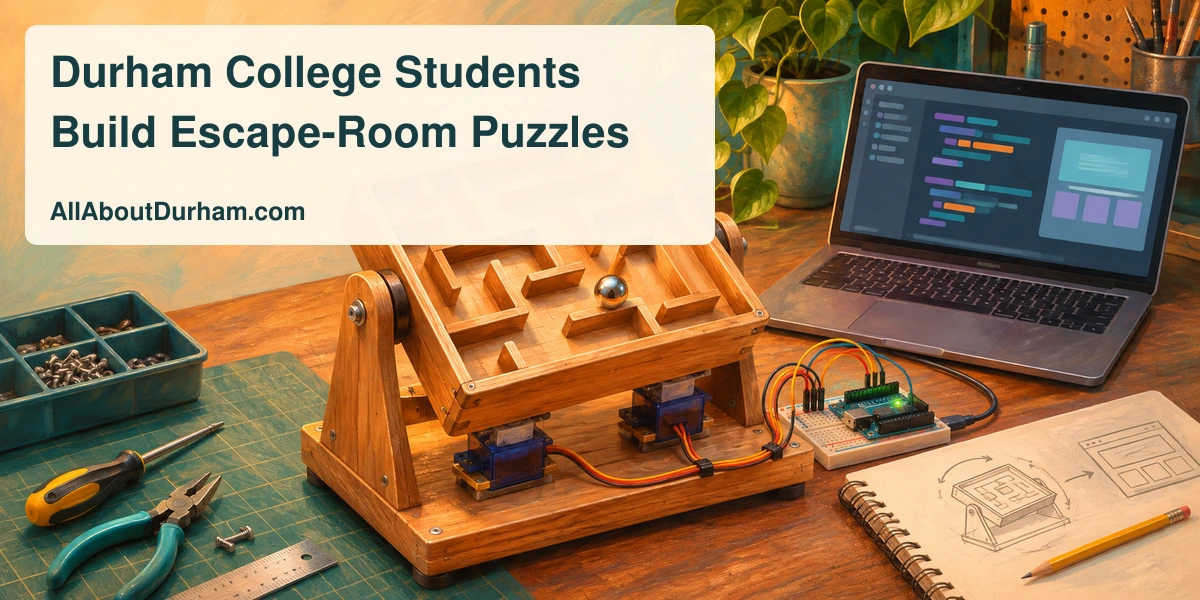
One example is a spy-themed room with four puzzle stages. Graduate Quam Bankole led development of a tilting maze in which players steer a metal ball toward its destination by moving the board in different directions.
Bankole helped his teammates develop the idea, assemble the hardware and write the software controlling it. The work introduced the group to the practical challenge of matching code with the behaviour of a physical device. According to the college, it was their first hardware project.
A separate haunted-house puzzle required another design change. Students originally planned to use a pressure sensor so that lifting an idol would activate the next part of the experience. When that approach did not work as intended, they switched to magnets and a distance sensor.
Both examples put troubleshooting at the centre of the assignment. Teams had to consider how sensors reacted, how devices communicated and how an individual puzzle contributed to the larger experience. A solution that worked as code still had to make sense to the person trying to solve the room.
Program coordinator Stuart Sackler described the projects as an opportunity to connect technical skills with art and storytelling. The college’s account emphasizes collaboration and creative problem-solving alongside programming.
The report describes student learning projects, not a public escape-room opening. It does not announce public booking dates, admission prices or visitor access. Daily Durham highlighted the projects in a November 18 report.