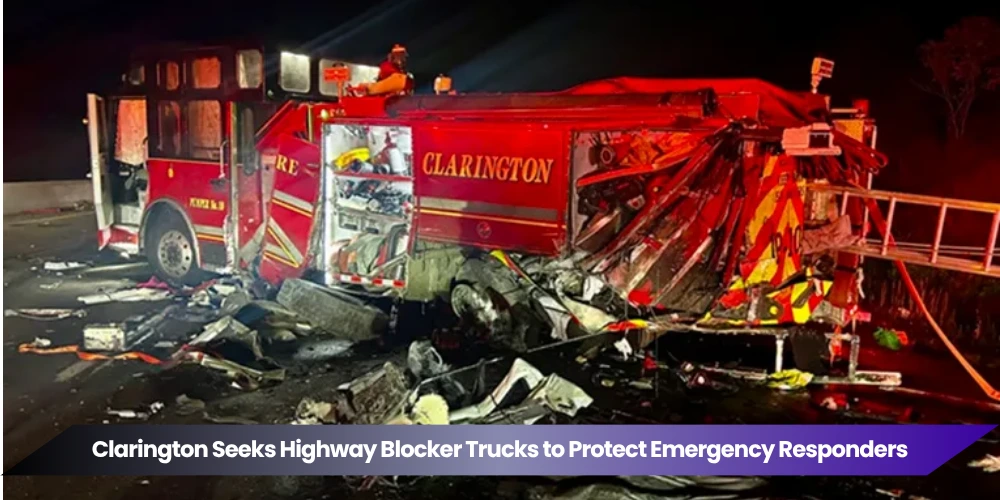
Clarington highway blocker trucks are being requested from Ontario following serious secondary collisions that injured firefighters working at crash scenes in Durham Region.
Clarington Council unanimously approved a motion asking the Ministry of Transportation to improve traffic protection for firefighters, paramedics, police officers and other personnel responding to incidents on provincial highways.
The request applies to Highway 401, Highway 407, Highway 418 and Highway 35/115 within the Municipality of Clarington.
Council wants the province to work with its highway maintenance contractor, Miller Group, to make dedicated blocker trucks, traffic-control equipment and trained personnel available for emergency incidents.
Recent Crashes Highlight Risks to Responders
The motion follows two serious incidents in late 2025 in which vehicles struck emergency scenes.
According to the information presented to council, two firefighters were injured in October when a transport truck crashed into a fire vehicle positioned at a Highway 401 collision scene in Clarington.
The following month, three Uxbridge firefighters were struck while responding to a separate collision near Wagg Road and Old Highway 47.
Durham Regional Police said the firefighters were assisting at a crash involving a transport truck and a pickup truck when a Hyundai SUV lost control and struck them. The SUV also hit the transport-truck driver before leaving the road.
A driver was later charged in connection with the Uxbridge incident.
Fire Trucks Currently Used as Protective Barriers
When dedicated traffic-protection equipment is unavailable, fire departments may position pumpers, tankers or other fire apparatus between approaching traffic and the emergency scene.
These vehicles act as physical barriers intended to protect responders, patients and damaged vehicles from another collision.
However, Clarington Council said relying on fire apparatus for this purpose creates additional problems.
A fire truck damaged while being used as a blocker may be unavailable for another emergency. Replacing or repairing specialized apparatus can also be expensive and may reduce the municipality’s overall emergency-response capacity.
Council also noted that using essential fire vehicles as the primary barrier does not eliminate the danger faced by firefighters working nearby.
Clarington Highway Blocker Trucks Requested
Clarington is asking the Ministry of Transportation and Miller Group to ensure that appropriate highway blocker trucks can respond promptly to collisions and other emergencies.
Dedicated blocker trucks are designed to provide a visible and physical barrier between moving traffic and an incident scene.
They may include warning lights, illuminated directional signs, impact-absorbing equipment and other traffic-control features.
The council motion also requests a provincial review of highway incident-response protocols.
Clarington wants those protocols changed so that municipal fire vehicles are not routinely required to act as primary blocker trucks, except when immediately necessary to protect life and safety.
Request Being Shared With Regional Partners
A copy of the resolution will be sent to the Ministry of Transportation, Miller Group and Clarington’s local member of provincial parliament.
The resolution will also be shared with neighbouring lakeshore municipalities in Durham Region and the Municipality of Port Hope.
Clarington Council approved the motion in a recorded vote of 7-0.
The province has not yet publicly announced whether it will provide additional blocker trucks or revise its highway emergency-response procedures.