









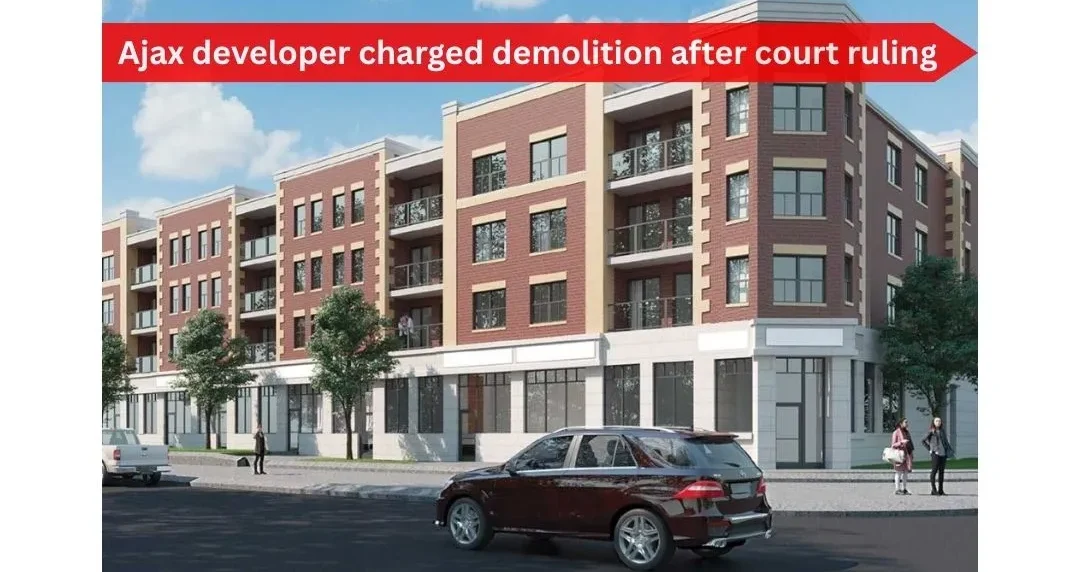
In a significant legal battle, the Ajax developer charged demolition after a court ruling upheld the town of Ajax’s decision to tear down a partially built structure that was erected without the proper permits. The case dates back to November 16, 2021, when the construction of a four-storey mixed-use project by First Avenue Properties began on a site at 599 Kingston Road West, located in the heart of Pickering Village.
The developer had purchased the land in 2015, which was previously used as an automotive repair facility. The project was approved by the town in 2021, but conditional approval did not include a full building permit. Construction began before the developer had received the necessary permits, and in October 2021, the town became aware that the development had exceeded the scope of the conditional permit. A visit by a building inspector revealed that First Avenue Properties had proceeded with the construction of above-grade elements without the required inspections or permits.


In response, the town issued an Order to Comply, ordering the developer to stop all work on the above-grade elements. However, despite this order, further construction continued, leading to the installation of core slabs on the second floor, which were meant to support the structure but had no authorization from the town. This non-compliance prompted further legal action, and the town ultimately sought a demolition order.

In a ruling by the Ontario Divisional Court, the demolition order was upheld, dismissing the appeal brought forward by the developer. First Avenue Properties argued that a demolition order would be unjust, as they claimed that circumstances beyond their control led to the violation of the permit conditions. However, the court rejected this argument, with Justice Annette Casullo ruling that the developer’s actions were a result of its own decisions. She stated that the developer had made a “calculated decision” to build beyond the scope of the permit without the required inspections and remediation. The court emphasized that the developer should not be rewarded for such conduct, making the demolition order the only just remedy.
The town of Ajax, led by Mayor Shaun Collier, welcomed the ruling as a “significant victory.” Collier emphasized that this decision reaffirmed the town’s commitment to upholding its planning and development rules. He noted that the process of holding the developer accountable had been lengthy and challenging, but the town remained steadfast in protecting the integrity of its community. “Our community will not be ignored, and developments that bypass the law will not be tolerated in Ajax,” Collier said in a statement following the court’s decision.
The developer, First Avenue Properties, had planned a mixed-use development called FiveNineNine. The proposed building was described as a low-rise modern apartment complex featuring retail stores at street level, along with on-site parking and waste facilities. However, the incomplete construction, which includes a ground floor, has remained dormant since November 2021 and has been sitting as an active construction site.
The legal battle between the Town of Ajax and First Avenue Properties serves as a reminder of the importance of adhering to zoning regulations and obtaining the necessary permits before beginning any construction. The case also underscores the challenges that municipalities face when holding developers accountable for building projects that bypass legal procedures.
Ongoing Impact and Future of the Property
As the demolition order progresses, the future of the site remains uncertain. First Avenue Properties has yet to respond to the latest ruling or provide public comment on the case. In the meantime, the town will continue to ensure that the demolition is carried out as ordered by the court.
Conclusion
The Ajax developer charged demolition case is a significant moment in the ongoing effort to maintain the integrity of Ajax’s planning regulations. The court ruling sends a clear message to developers: projects that disregard permits and legal processes will not be tolerated. It also reinforces the role of local governments in ensuring that development is carried out responsibly and in accordance with the law.