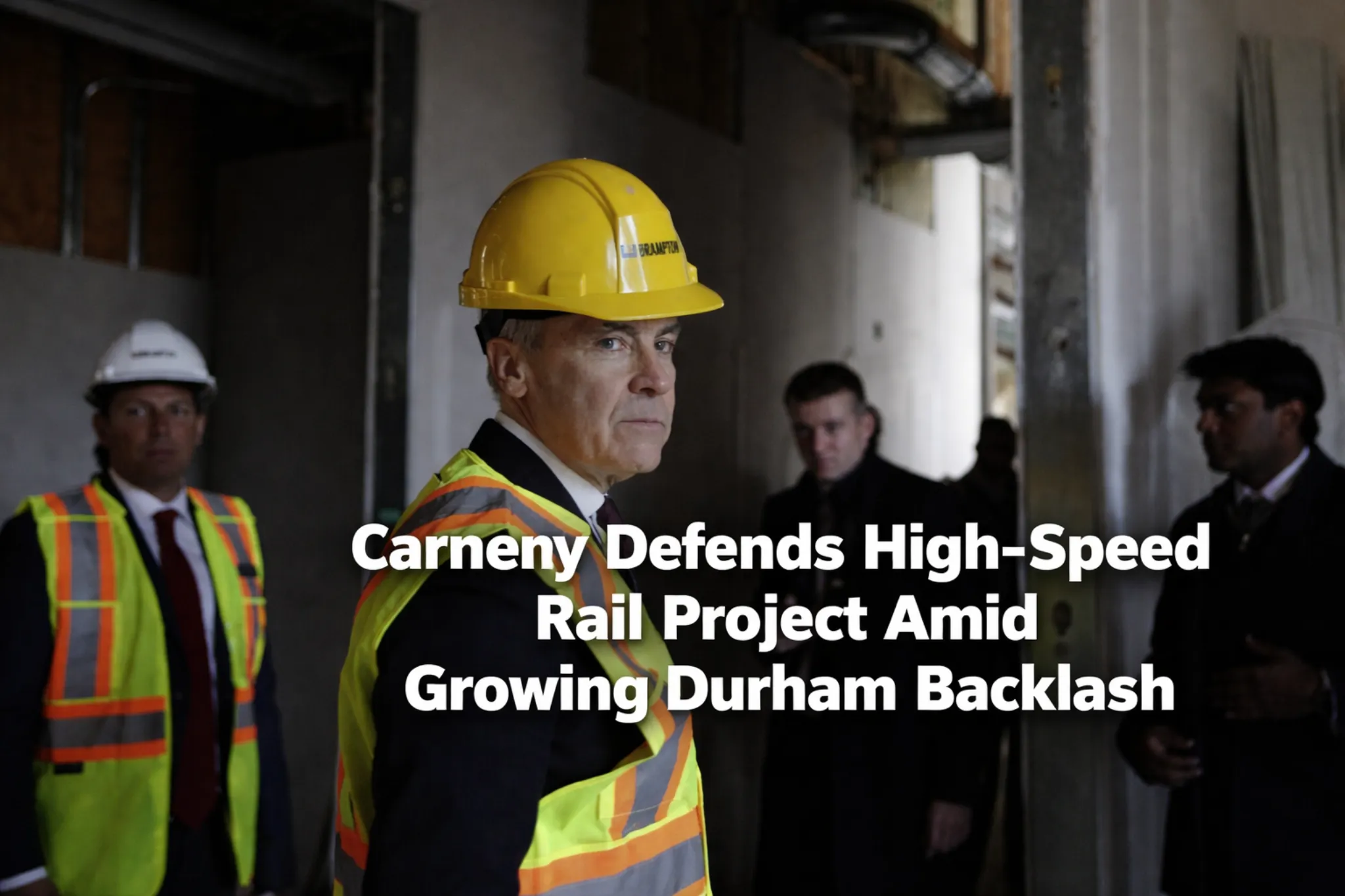
Prime Minister Mark Carney is standing firm on his government’s vision for a multi-billion-dollar high-speed rail network, even as local opposition intensifies across the Durham Region. During a news conference on Tuesday, the Prime Minister described the project—which aims to link Toronto and Quebec City with trains traveling up to 300 km/h—as a vital “nation-building” endeavor that will revolutionize Canadian travel and “cushion the blow” of future economic shifts.
Economic Boon vs. Rural Displacement
The proposed rail line is estimated to cost between $60 billion and $90 billion and is projected to create over 50,000 jobs. Carney emphasized that the project would contribute more than $35 billion to the national economy, offering a faster, more sustainable alternative to air and car travel. However, the path to progress is meeting resistance in rural and suburban communities where land expropriation is a looming reality.


In the Durham Region, where the corridor is expected to cut through a 10-metre swath of land in various municipalities, residents in Clarington and Scugog have raised concerns about the loss of farmland and the bisection of local road networks. Carney sought to downplay these fears, stating that the actual footprint of the route is relatively narrow and that all affected landowners will receive fair compensation.
The Alto Plan and Durham’s Involvement
The Crown corporation Alto, established to oversee the project, has identified a broad 60-kilometre study corridor that traverses the heart of the Durham Region. While the final right-of-way will be much smaller, the “Logan-style” focus on high-speed efficiency requires long, straight segments that often clash with existing property lines.
Recent interoffice memorandums from Durham municipalities indicate that while the region currently lacks a confirmed station stop, local leaders are lobbying for a “Durham Hub” to ensure the project benefits the local economy rather than just passing through. Construction on the first phase, connecting Montreal and Ottawa, is slated for 2029, with the Toronto-to-Ottawa segment—passing through Pickering, Ajax, and Whitby—to follow.
Ethics and Oversight at the Top
The project has also faced political scrutiny regarding potential conflicts of interest. Finance Minister François-Philippe Champagne has officially recused himself from all discussions involving Alto due to his partner, Anne-Marie Gaudet, serving as the corporation’s Vice-President of Environment.
Carney defended the recusal on Tuesday, stating that the government is following strict ethics rules to ensure the project remains transparent. As environmental field studies expand across Oshawa and Clarington this summer, the federal government maintains that the long-term benefits of a “connected Canada” outweigh the immediate “rough ride” of land negotiations. For Durham commuters currently facing high gas prices and highway congestion, the promise of a three-hour trip to Montreal remains a distant, yet transformative, prospect.