November 15, 2026 edition · Historical reference: November 15, 1926 · Sourced archive snapshot. This feature examines the cartage listings in Oshawa’s 1926 city directory. It is not a report of events on November 15. The annual source identifies names and addresses for its year, but cannot tell us what any carrier moved on that particular day.
A city’s history of movement is not only a story of passengers. Goods, baggage and other loads create a different set of questions: who could be looked up to carry something, and where did the directory tell a customer to find them? For Oshawa in 1926, one useful starting point is a short classified section headed Cartage.
On printed page 242, twelve entries bring together individual names and businesses with more descriptive trading names. Read as a group, they offer a small address-book portrait of a service category that can be easy to overlook beside the city’s factories. Read carefully, they also show the difference between a place to begin research and a complete account of how a business worked.
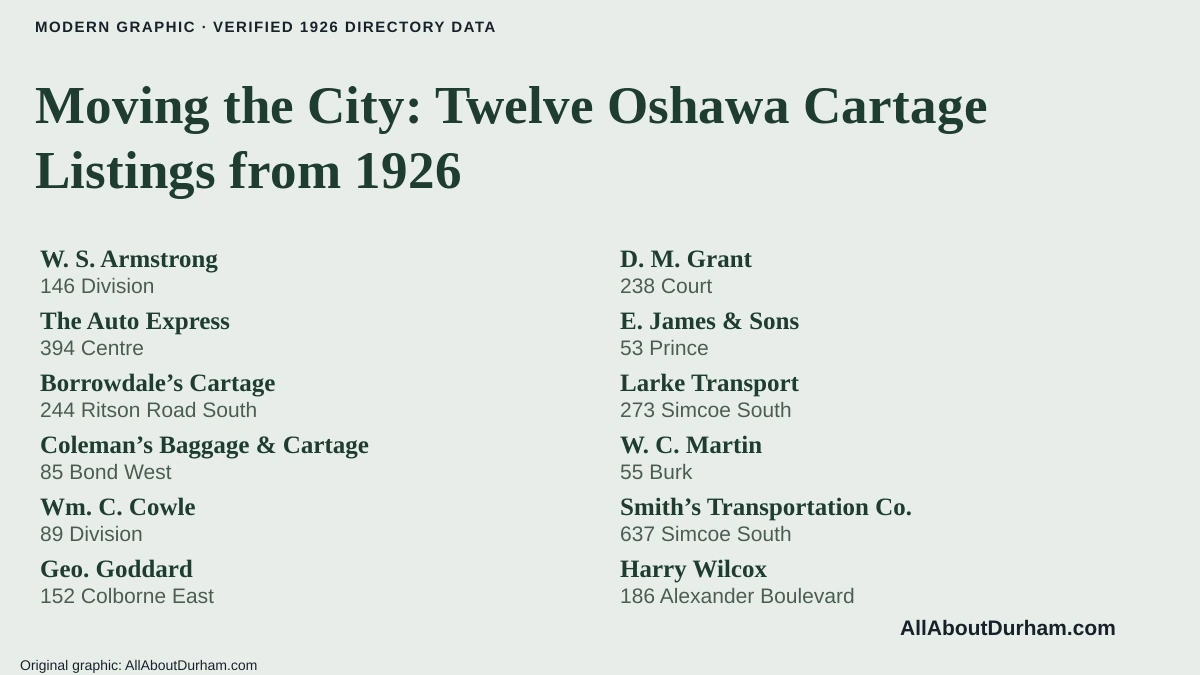
Twelve names in the cartage section
The following entries were checked against the original page image, scan leaf 123. Names are presented in normal reading order, with punctuation regularized and abbreviated street directions expanded. Initials and abbreviated given names are retained rather than guessed.
- W. S. Armstrong — 146 Division.
- The Auto Express — 394 Centre.
- Borrowdale’s Cartage — 244 Ritson Road South.
- Coleman’s Baggage & Cartage — 85 Bond West.
- Wm. C. Cowle — 89 Division.
- Geo. Goddard — 152 Colborne East.
- D. M. Grant — 238 Court.
- E. James & Sons — 53 Prince.
- Larke Transport — 273 Simcoe South.
- W. C. Martin — 55 Burk.
- Smith’s Transportation Co. — 637 Simcoe South.
- Harry Wilcox — 186 Alexander Boulevard.
The addresses matter as much as the names. Division appears twice, for Armstrong and Cowle, at different numbers. Simcoe South also appears twice, for Larke Transport and Smith’s Transportation Co. The other entries point to Centre, Ritson Road South, Bond West, Colborne East, Court, Prince, Burk and Alexander Boulevard. That makes ten distinct street references across these twelve listings.
Not just one transport street
This is a geographically varied list in the limited sense that it names several streets. It is not a route map. A listed address might be the point through which a person or business could be contacted; the selected entries do not label every location as an office, yard, stable, garage or residence. Turning each address into a freight depot would add information that the page does not supply.
The two Division listings make a useful example. W. S. Armstrong is attached to 146 Division, while Wm. C. Cowle is attached to 89 Division. The shared street does not make them the same operation, nor does it demonstrate a partnership or competition for particular customers. What it gives us is two separate name-and-address pairs to look for in other records.
Likewise, Larke Transport at 273 Simcoe South and Smith’s Transportation Co. at 637 Simcoe South should remain separate references. A researcher working with an old bill or a labelled photograph can compare the full address, not simply the street name. That small discipline helps prevent a plausible connection from becoming an unsupported identification.
What the business names actually tell us
Coleman’s entry explicitly includes both baggage and cartage in its name. That is a useful identifying detail when comparing it with a document carrying similar wording. It does not tell us which railway station, hotel or household, if any, used the service. No particular customer or journey is established by this listing.
The Auto Express is another distinctive name, and the scan gives its address as 394 Centre. The word Auto is part of the recorded name; it is not a fleet inventory. We cannot use that word to assign a vehicle model, count trucks or reconstruct a delivery schedule. The same restraint applies to the broader labels Transport and Transportation in other entries.
E. James & Sons is listed at 53 Prince. The family-style wording is a useful search term, but this short entry does not identify the sons or explain their roles. Several other listings provide only initials or abbreviated given names. Keeping those forms intact leaves room for later confirmation without introducing an identity that the source has not established.
How to investigate a surviving delivery record
If a family collection contains a receipt, baggage tag or moving account, these listings can provide a first comparison. Start with the document itself: record its date, the exact business name, the address and any description of the service. Note whether each detail is printed or handwritten. A directory match can support an association, but the dated document remains the evidence for the individual transaction.
Suppose a record names a carrier without an address. Finding that name in this list would create a promising lead, not an automatic identification. A matching set of initials, a second address reference or another contemporary record would make the connection more persuasive. If a street number differs, preserve the difference. It may point to a change of address, a different person, an error or something not yet understood.
The next step could be to consult directories from adjacent years. A repeated listing would help establish that a name appears in more than one annual record. A changed listing would narrow the period worth investigating. Neither result, on its own, supplies an exact opening, moving or closing date. Those dates need evidence tied more closely to the event.
The work still outside this snapshot
The cartage section does not provide prices, wages, load sizes, delivery distances or operating hours. It cannot support a comparison between the cost of a move in 1926 and one today. Nor can it establish whether a particular load travelled by horse-drawn vehicle or motor vehicle. Those are worthwhile questions, but answering them requires a different kind of source.
We have not verified the modern locations of these premises. Historical numbers are research references, not a present-day walking route. Establishing a surviving building would require checking address continuity and property evidence before attaching a 1926 business to a modern facade.
For now, the page preserves something narrower and solid: twelve listings under one transport-related heading, spread across ten street references. That is enough to make the category visible and to give readers concrete leads for further research. More source-based local features can be found in our History archive.
Source and archive note
Primary source: Henry Vernon & Son, 1926 City of Oshawa Directory, fourth edition, printed page 242, Cartage section. View scan leaf 123, left-hand page, right column. Internet Archive’s catalogue identifies the original as held in the Local History Room at Oshawa Public Library. All twelve entries were visually checked; automated text served only as a finding aid.
The newspaper run and index returned access errors during research. This does not prove an exact-date or nearby issue is missing, and no access controls were bypassed. The contemporary annual directory is the fallback source, so this is explicitly an archive snapshot, not exact-day news. The article and featured graphic are original. No archive scan, photograph, advertisement or protected passage is reproduced. The graphic is a modern symbolic design, not an image of a historical vehicle, business or delivery.