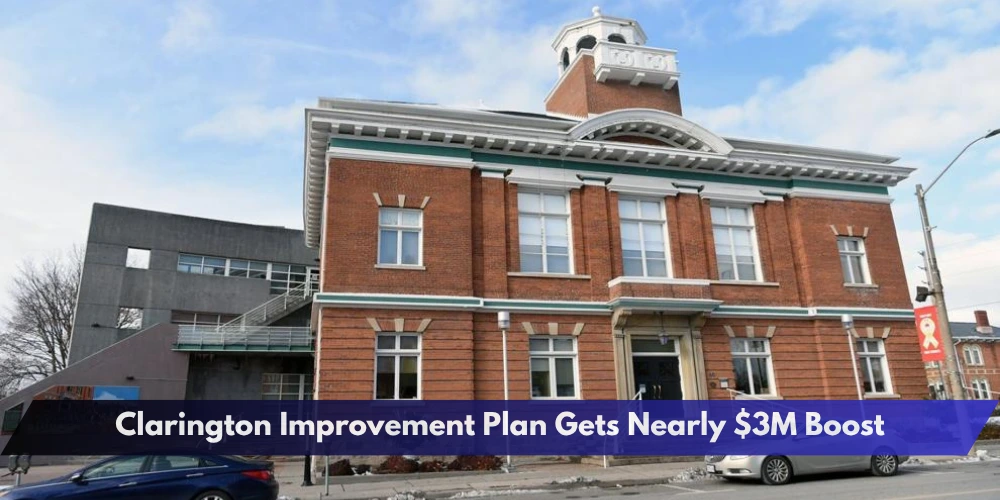
The Clarington Improvement Plan is expanding across the entire municipality, opening the door to new financial incentives for housing, businesses, industrial investment, agricultural diversification and property redevelopment.
Clarington council approved the updated Community Improvement Plan, or CIP, at its Aug. 10 meeting.


The biggest geographical change is that the entire municipality will now be designated as a Community Improvement Project Area. Previously, Clarington’s programs were focused primarily on designated downtown areas.


The municipality’s official review explains that its earlier CIPs were centred on Bowmanville, Newcastle, Orono and Courtice. The updated approach was developed to create a unified framework and potentially extend incentives throughout Clarington.
Nearly $3 Million Available Through Existing Funds
No new funding request accompanies the plan at this stage.
Instead, Clarington will continue using the existing $210,000 annual CIP budget while creating a new reserve to support the expanded program.
According to the information presented with the approval, approximately $994,000 already allocated to CIP programming in the municipality’s general capital reserve will be moved into the new CIP reserve.
Another $2 million in developer-funded contributions will be transferred from Clarington’s affordable housing reserve.
Those $2 million funds are specifically intended for the plan’s Additional Dwelling Unit program, rather than being available for every type of CIP incentive.
Together, the amounts associated with the expanded program approach roughly $3 million, although they serve different purposes and should not be described as a single unrestricted grant fund.
Housing Becomes Major Priority
Housing is one of the most important components of the new Clarington Improvement Plan.
Programs are intended to encourage additional rental housing through Additional Dwelling Units and purpose-built rental projects.
Affordable rental housing will also be an important focus.
The municipality’s official CIP review specifically identified purpose-built rental and affordable housing development as areas that could receive targeted incentives under the updated framework.
The $2 million dedicated to Additional Dwelling Units could help create more housing within existing neighbourhoods while increasing Clarington’s overall rental supply.
Businesses and Downtown Areas Remain Included
The broader plan does not mean Clarington is abandoning its traditional downtown improvement programs.
Commercial property owners may still be able to access incentives for façade improvements, signage, accessibility upgrades and building improvements.
The municipality also wants to encourage new commercial and mixed-use development while maintaining the individual character of Clarington’s historic downtown areas.
Clarington has used Community Improvement Plans for years as a way to encourage private-sector investment in improvements and redevelopment. Under Ontario’s Planning Act, municipalities can use CIPs to establish grants, loans and other incentives for projects that advance local priorities.
Industrial and Employment Investment Targeted
The expanded Clarington Improvement Plan also gives the municipality greater flexibility to support employment lands.
Incentives could assist existing industrial businesses seeking to expand while helping attract major new employers.
Particular attention will be given to industries connected to Clarington’s economic strengths, including nuclear energy and related engineering, environmental and technical sectors.
This approach aligns with Clarington’s broader economic development strategy, which previously identified reviewing and updating CIP incentives as an economic development priority.
Farms, Brownfields and Tourism Also Included
Rural properties could benefit through programs encouraging on-farm diversification.
Potential assistance could help agricultural businesses improve buildings and signage or develop new agri-tourism activities.
Brownfield redevelopment is another priority. Incentives may help offset some of the costs associated with environmental assessments, cleanup and redevelopment of contaminated or underused properties.
Conference and banquet facilities are also targeted because Clarington wants to encourage investment that can generate additional tourism, business activity and events.
Municipality-Wide Approach Marks Major Change
The most significant aspect of the Clarington Improvement Plan is its shift from a small number of downtown districts to a municipality-wide economic development tool.
Clarington’s official review said expanding the project area would provide greater flexibility to establish new incentive programs while still allowing particular neighbourhoods or sectors to receive targeted support.
The result is a much broader strategy covering housing, downtown revitalization, employment lands, agriculture, brownfields and tourism-related development.
If successful, municipal officials believe the plan could encourage private investment while helping address some of Clarington’s most pressing housing and economic development priorities.