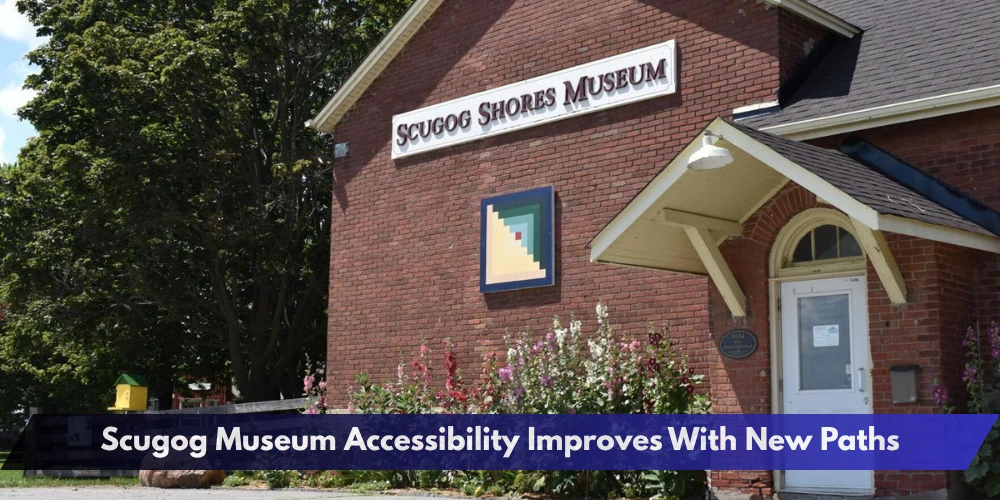
Scugog Museum Accessibility has improved significantly with the installation of new pathways and ramps designed to make Scugog Shores Museum Village easier to explore for visitors of all abilities.
The museum, located at 16210 Island Road on Scugog Island, has added a network of accessible pathways connecting its main entrance with historic buildings throughout the property.


Before the improvements, visitors often had to travel across grass to reach many of the museum’s structures, creating difficulties for people using wheelchairs, walkers or other mobility aids.


The new upgrades aim to provide a more inclusive experience while preserving access to the historic buildings that tell the story of the Lake Scugog area.
Four historic buildings receive new ramps
Four accessibility ramps have also been installed at museum buildings that were previously reached primarily by stairs.
The upgraded structures include the log cabin, Rodman cabin, Lee house and church.
The church dates to 1860, while the Lee house was constructed in 1865.
Adding ramps to these heritage structures allows more visitors to experience them while maintaining their historical role within the museum village.
The new pathway network also connects the museum’s front office and entrance area with the different historic sites spread throughout the grounds.
Provincial grant supports accessibility project
The Scugog Museum Accessibility improvements were supported through a combination of provincial and community funding.
The project received a $30,000 grant through Ontario’s Enhancing Access to Spaces for Everyone program.
Local organizations also provided financial support.
The 100 Men of Scugog contributed $6,200, while the Lake Scugog Historical Society provided another $4,000 toward the improvements.
Together, the funding helped make it possible to install the pathways and ramps while preserving the historic character of the site.
The Township of Scugog said the improvements will make it easier for visitors of different abilities to explore the museum and learn about the region’s history.
Museum recreates an early Scugog community
Scugog Shores Museum Village contains 10 historic structures connected to the local area.
Some of the buildings date back as far as 1845.
The collection includes houses, stores, a church and a schoolhouse arranged to recreate the appearance and atmosphere of a 19th-century community.
Some structures were originally built on the museum grounds, while others were relocated from elsewhere in Scugog to preserve them.
Visitors can move between the different buildings and experience what life may have looked like in an early pioneer settlement.
The site’s historic schoolhouse, built in 1880, also serves as the museum’s main office and entrance.
Making heritage more accessible
Historic buildings can present accessibility challenges because many were constructed long before modern accessibility standards existed.
Steps, uneven ground and narrow approaches can prevent some visitors from fully experiencing heritage sites.
The new improvements at Scugog Shores Museum Village are designed to address some of those barriers without taking away from the historic character of the property.
Accessible pathways now provide a more stable route across the grounds, while ramps give visitors additional ways to enter several significant buildings.
The Scugog Museum Accessibility project therefore allows a broader range of residents and visitors to experience local history firsthand.
By improving access to its heritage buildings, the museum can continue preserving Scugog’s past while making that history available to more members of the community.