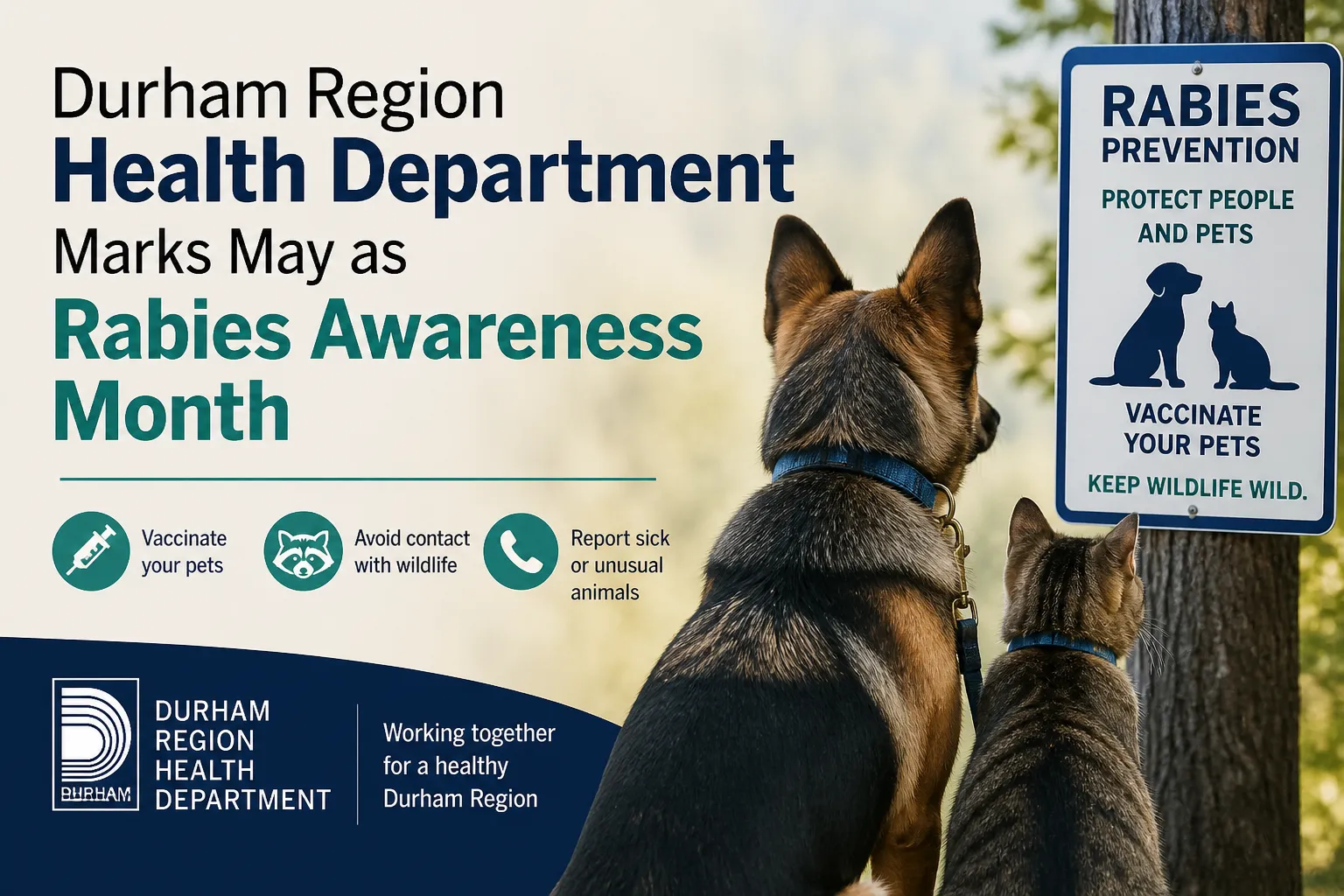
The Durham Region Health Department has officially designated May as Rabies Awareness Month, issuing a critical public health reminder to all residents, educators, health care providers, and law enforcement. The primary objective of this annual awareness campaign is to remind the community that all animal bites or scratches involving humans must be reported immediately to the Health Department for a formal risk assessment. While rabies is a preventable condition through timely intervention and vaccination, it is almost always fatal for both humans and animals once clinical symptoms begin to manifest.
In the Durham Region, the rabies virus is most commonly found in local wildlife populations, specifically bats, foxes, skunks, and raccoons. Transmission typically occurs through the bite or scratch of an infected animal, or when the animal’s saliva comes into contact with open wounds or mucous membranes. To mitigate these risks, public health officials emphasize that avoiding direct contact with these animals is the most essential step in preventing exposure.


Role of Educators and Child Care Providers
The Health Department has highlighted the vital role that educators play, particularly those working in schools and child care centers, in teaching children about wildlife safety. Because children are often naturally curious about animals, they should be taught several key safety protocols:


-
Children must be reminded never to approach wild animals seen on school or child care property.
-
If a child encounters a sick or injured animal, they must be instructed to immediately tell an adult rather than trying to help the animal themselves.
-
In the event a sick animal is discovered, adults should attempt to safely contain the animal if possible without making direct contact.
-
The Health Department must be contacted right away to determine if there is a potential risk of rabies exposure.
Mandated Vaccinations and Responsible Pet Ownership
A cornerstone of rabies prevention in Ontario is responsible pet ownership. Under Ontario Regulation 567/90 of the Health Protection and Promotion Act, it is a legal requirement for all owners to maintain up-to-date rabies immunizations for dogs, cats, and ferrets over three months of age. Brenda Kwan, Manager of Health Protection, noted that pet owners play a direct role in protecting their families by ensuring all domestic animals receive annual vaccinations.
Further precautions for pet owners include:
-
Keeping all vaccinations current for household pets.
-
Supervising pets when they are outside and keeping them indoors at night to avoid encounters with nocturnal wildlife.
-
Contacting local animal control agencies to handle and remove sick wildlife from residential neighborhoods.
-
Spaying or neutering pets to reduce the population of unwanted animals that may lack regular veterinary care.
How to Report an Exposure
Residents who encounter sick wildlife or suffer an animal bite are encouraged to visit durham.ca/Rabies for resources and schedules for low-cost vaccination clinics. To report an animal bite or scratch, residents can call 905-668-2020 or 1-800-841-2729, or use the online Rabies Animal Bite/Exposure Reporting Form. For general inquiries, residents within regional boundaries can dial 311 to reach myDurham services.