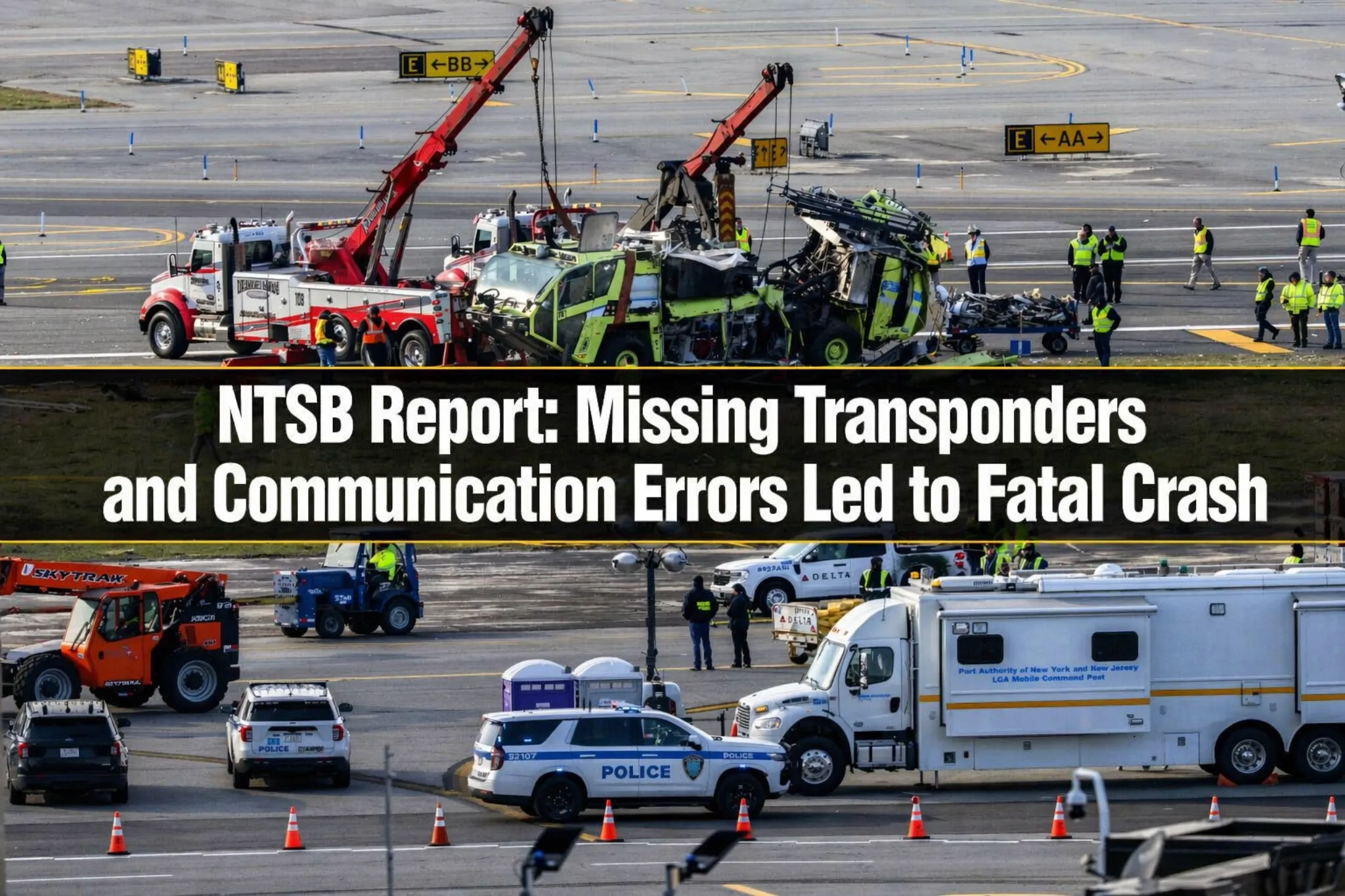
A preliminary LaGuardia airport crash report released on Thursday by the National Transportation Safety Board (NTSB) has identified a series of catastrophic system and communication failures that led to the deaths of two Canadian pilots last month. Investigators found that the Port Authority fire truck that collided with the Air Canada Jazz Aviation jet was not equipped with a transponder. This omission meant the airport’s ground surveillance system could not identify the vehicle’s position or predict the collision, preventing an automated alert from being generated for air traffic controllers. At the time of the impact, only two of the seven responding emergency vehicles were visible as distinct radar targets on the controller’s screen.
The LaGuardia airport crash report paints a harrowing picture of the final moments before the collision. Radio transmissions between the tower and the emergency vehicles were obscured approximately two minutes prior to impact. Although a “stop, stop, stop” command was broadcast, the fire truck operator was unsure who the message was intended for until it was too late. By the time the operator realized the danger, the truck was already entering the active runway. Compounding the tragedy, the local controller had cleared the fire truck to cross the runway despite the Air Canada plane being only 400 metres from the intersection and a mere 40 metres above the ground.


The physical evidence detailed in the LaGuardia airport crash report underscores the violence of the impact. The fuselage of the Jazz Aviation plane was crushed from the nose back to the front lavatory. The force was so extreme that the pilot seats—occupied by Captain Antoine Forest, 30, and First Officer Mackenzie Gunther, 24—were completely sheared from the aircraft and found in the debris field. Both pilots were killed instantly. Remarkably, all passenger seats remained intact, and a flight attendant who was ejected from the plane during the collision survived with leg fractures. Approximately 40 passengers and crew members required hospitalization following the nightmarish event.


A technical anomaly regarding the airport’s safety lighting was also noted. The red runway entrance lights, designed to warn ground traffic of an approaching aircraft, turned off just three seconds before the collision. The report explains that the system is programmed to turn these lights off sequentially as a plane passes over them; in this instance, the timing allowed the fire truck to enter the path of the jet at the exact moment of touchdown. Jazz Aviation has confirmed they are cooperating fully with the NTSB as the investigation shifts toward long-term safety recommendations for ground vehicle tracking at major international airports.
For the aviation community in the Durham Region and across Canada, the findings of this LaGuardia airport crash report are a sobering reminder of the importance of redundant safety systems. The lack of transponders on emergency vehicles—a standard at many other international hubs—is expected to be a primary focus for investigators moving forward. As the families of the two young pilots seek answers, the NTSB will continue to analyze flight data recorders and tower audio to determine why the local controller cleared the vehicle to cross into the path of an arriving flight. A final report with formal safety mandates is expected within the next 12 to 18 months.